‘Building Relationships,’ Creating Community in NHS Classroom

April 20, 2026
• Via a small local grant, a previously unadorned classroom at the high school will, staff hope, provide new opportunities for connection.
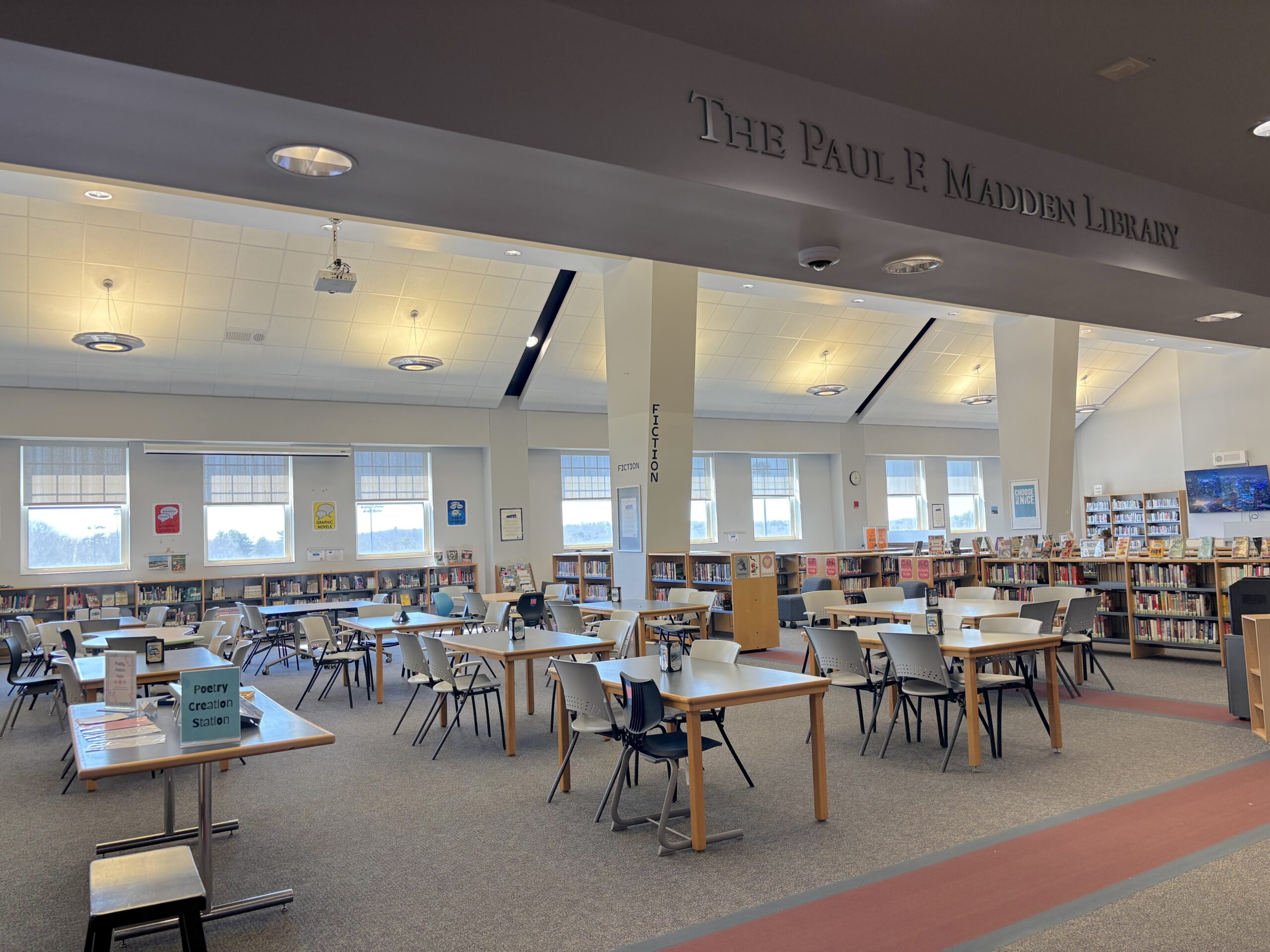
The Needham High School library will become home to the school’s first dedicated space for restorative justice practices, which have been incorporated within the district in recent years.
Through a Needham Education Foundation grant of $1,059, the library will add additional furniture and supplies to room 410, a classroom off of the main entrance of the library. The space offers students and faculty room to hold circles, where they can come together to talk and build community.
Teacher-librarian Kelly McDaniel, who co-wrote the grant request, began brainstorming after the district offered staff training on restorative justice practices. McDaniel, in her first year at NHS, said she and other staff looked to create an additional space open to all staff and students.
The district’s website states restorative justice practices “create a culture of connectivity where all members of the school community feel valued.” The district links to another website that defines restorative justice as a way “to build and repair relationships among community members, oftentimes serving as an alternative to punitive discipline.” In practice, that involves groups sitting around in a circle to share.
Circles are currently implemented in individual classrooms and aim to provide moments of reflection, mindfulness, connection and acknowledgment after harm, NHS Restorative Justice Coordinator and Interim Assistant Principal Natalie Guthrie said. That may look like anything from an icebreaker to a more serious conversation when students are not in harmony, she said.
McDaniel identified the library as a space well-suited for that work, and one where students already gather to study, collaborate and share. Restorative justice can help students and the broader school community build connections and foster understanding after wrongdoing, McDaniel said.
“We just know that kids are really stressed, and sometimes when they make poor decisions, there’s a lot of other factors to it,” McDaniel said. “In this restorative justice realm, instead of just handing out a consequence, you could say, we are building relationships with them so that they learn from their mistakes, they grow from them, and then also, at the same time, build relationships with teachers and administrators so that they can grow and continue to make better decisions.”
McDaniel applied for the NEF grant with then-library program specialist Jennifer Maw. The award was one of eight in the NEF’s winter cycle, totaling $27,971.
With the new funding, McDaniel said the library plans to add to room 410 a circle rug, floor cushions, new lighting, a mural and talking pieces groups will use to take turns sharing.
Guthrie, who was not part of the grant application, said the school community will benefit from the transformed space.
“This is going to open the door to something exciting and new,” Guthrie said, “that, one, we’ve never had, so it’s going to be innovative. But two, you don’t have to [ask], ‘Is that classroom empty? Is this conference room free?’ There’s actually a space where you know that you can go, it’s going to be free and it’s going to be available to you.”
As it is now, room 410 “is super boring,” said Chris Gosselin, the district’s director of instructional technology and innovation. The space doesn’t lend itself well to collaboration, he said, and students don’t always need a traditional classroom with desks — they need one “that is flexible and responsive to their needs,” which is what the grant aims to do.
“Students come to school to do a lot of things. However, most people often only think of the academic first,” Gosselin said. “We want our students to be resilient contributors to society and the world in which they live, and part of that is developing those mindsets and those skills. A lot of that work can be done through community-building work in restorative justice practices.”
While previously leading circles in her own classroom, Guthrie said she found the practice to be “incredibly moving, incredibly helpful in creating community.” Instead of a regular suspension of detention, teachers can instead hold conversations to understand the intent and impact behind students’ actions, she said.
The space will encourage both students and teachers to learn about restorative justice and engage with the practice in a comfortable environment, Guthrie added.
“It’s going to pique their interest,” she said, “and it’s also going to give them a space where, if they probably want to just move from their own classrooms and do something that feels different, looks different, in a different space, and they have the opportunity to do that as well.”