Olin Eyes New Beginning, Explores AI

September 28, 2026
• As the newly installed president of the college, R. May Lee takes on risks and promises a 2.0 partner class.
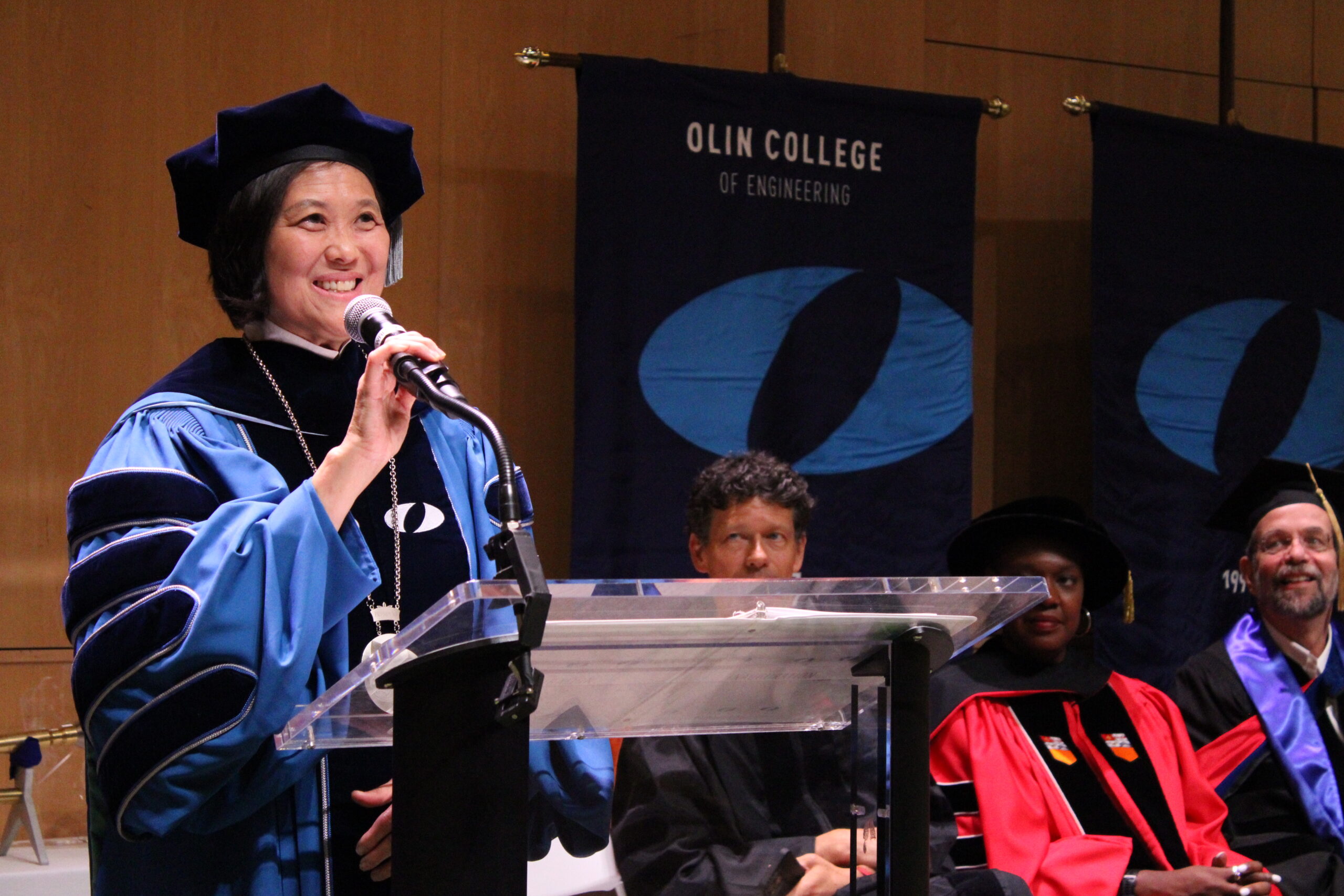
With a full school year in the books, Olin College of Engineering formally inaugurated its third ever president, R. May Lee, in a ceremony Friday afternoon. Speeches from faculty and students, past and present, applauded Lee’s risk-taking and authenticity but were punctuated with reflections on artificial intelligence and the role of higher education.
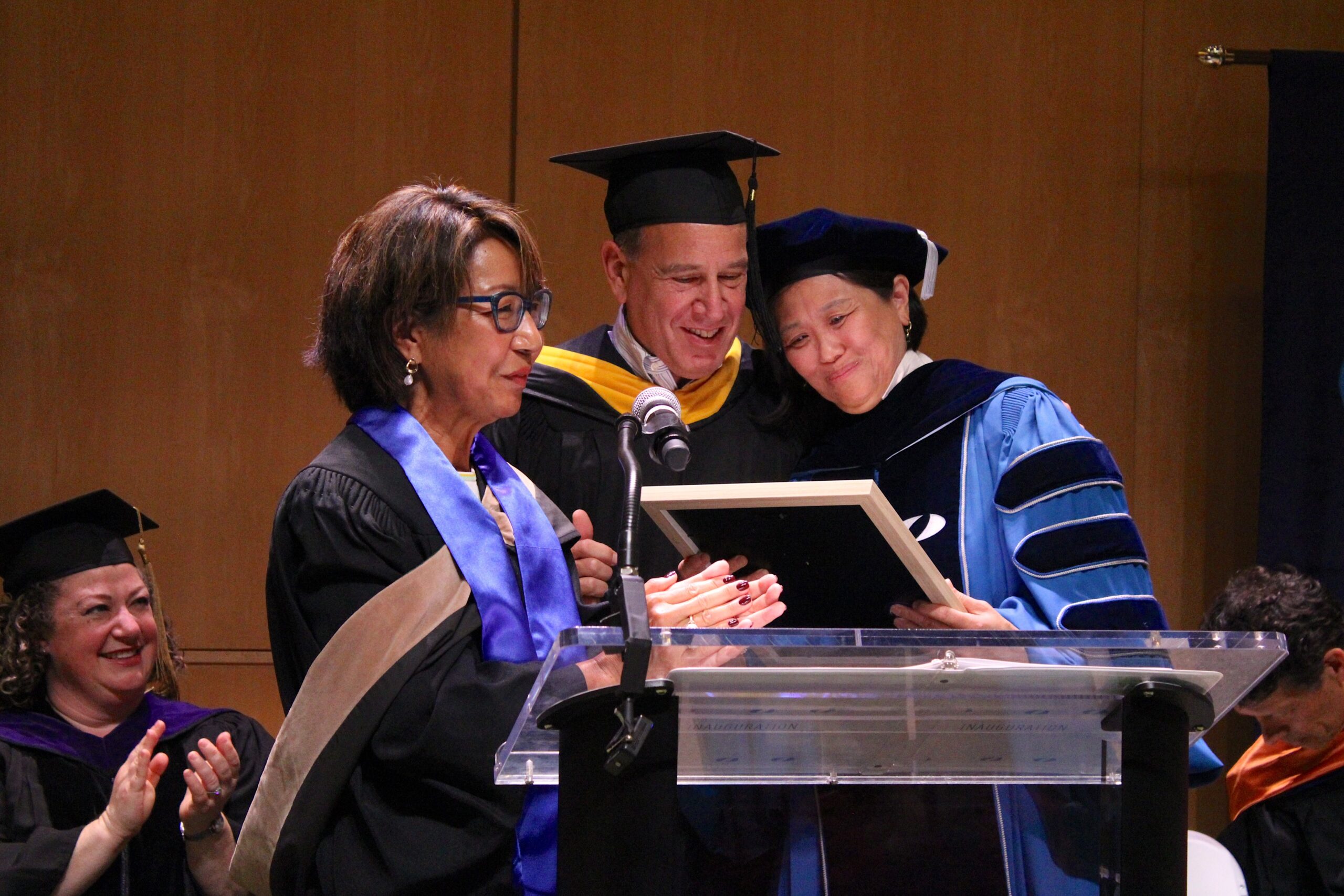
The inauguration — moved indoors to Norden Auditorium due to the impending nor’easter — signaled an inflection point in the university’s young history. It was themed around “co-authoring the living blueprint,” a reference to Olin’s founding mission to reimagine engineering school and its approach to innovation and problem-solving.
Before admitting its inaugural class in 2002, Olin held a “partner year,” where students and faculty created the curriculum together. During her remarks Friday, Lee said the college plans to admit “an Olin 2.0 partner class” that “will spend a year exploring what learning looks like with AI.”
“How do faculty guide students to learn with AI rather than circumvent learning? What happens to the role of faculty? Does [Professor] Mark Somerville become a Jedi master? And can AI open access to engineering for students from less privileged backgrounds?” Lee asked. “And in keeping with our mission to transform engineering education, we will share what we learn with our faculty and colleagues here, with our students, and with colleagues at other colleges.”
The inauguration coincided with the reunion of Olin’s first graduating class, the Class of 2006.
Lee comes to Olin via Rensselaer Polytechnic Institute, where she served as vice president and chief strategy officer for institutional impact. She led the development of New York University’s Shanghai campus while vice chancellor, was founding dean of ShanghaiTech University’s School of Entrepreneurship and Management and previously worked on Wall Street.
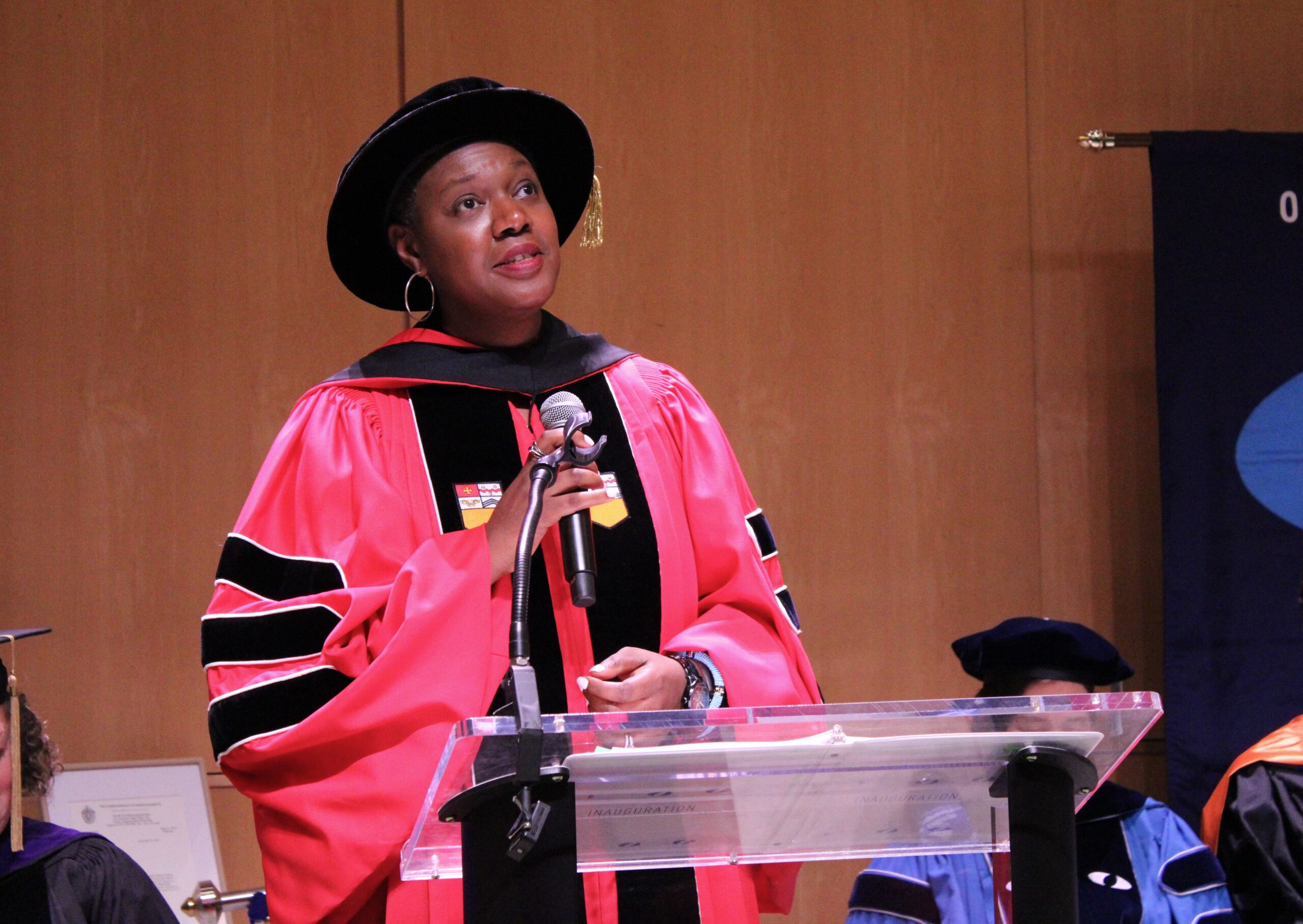
Provost Shayla Sawyer Armand, who met Lee at RPI, listed some of those various experiences with admiration.
“She’s an NYU lawyer, a Wall Street bro, an entrepreneur, somehow an architect, a design leader, an athlete, a founder of universities in China, an adjunct professor of strategies,” Sawyer Armand said. “She’s many things, but I noticed a common trend in every story: she keeps good company.”
May is helping Olin in “redefining engineering education and what engineers build — not just technology, but society,” she added. Increasingly, AI has come to the forefront of those conversations.
Ally Bell, a 2024 Olin graduate, remarked on Olin’s unique approach to engineering and problem-solving before revealing that portion of her speech was AI generated. Instinct, an AI tool, read through her email and crafted the speech “without me asking,” Bell said.
AI’s power and intellect can be alarming — “guys, we are cooked,” Bell joked — but it also provides “the most exciting moment of all time to be an engineer and to be an engineering school.” Bell said she has faith that, with Lee at the helm, Olin will be well-positioned to face each new technological shift.
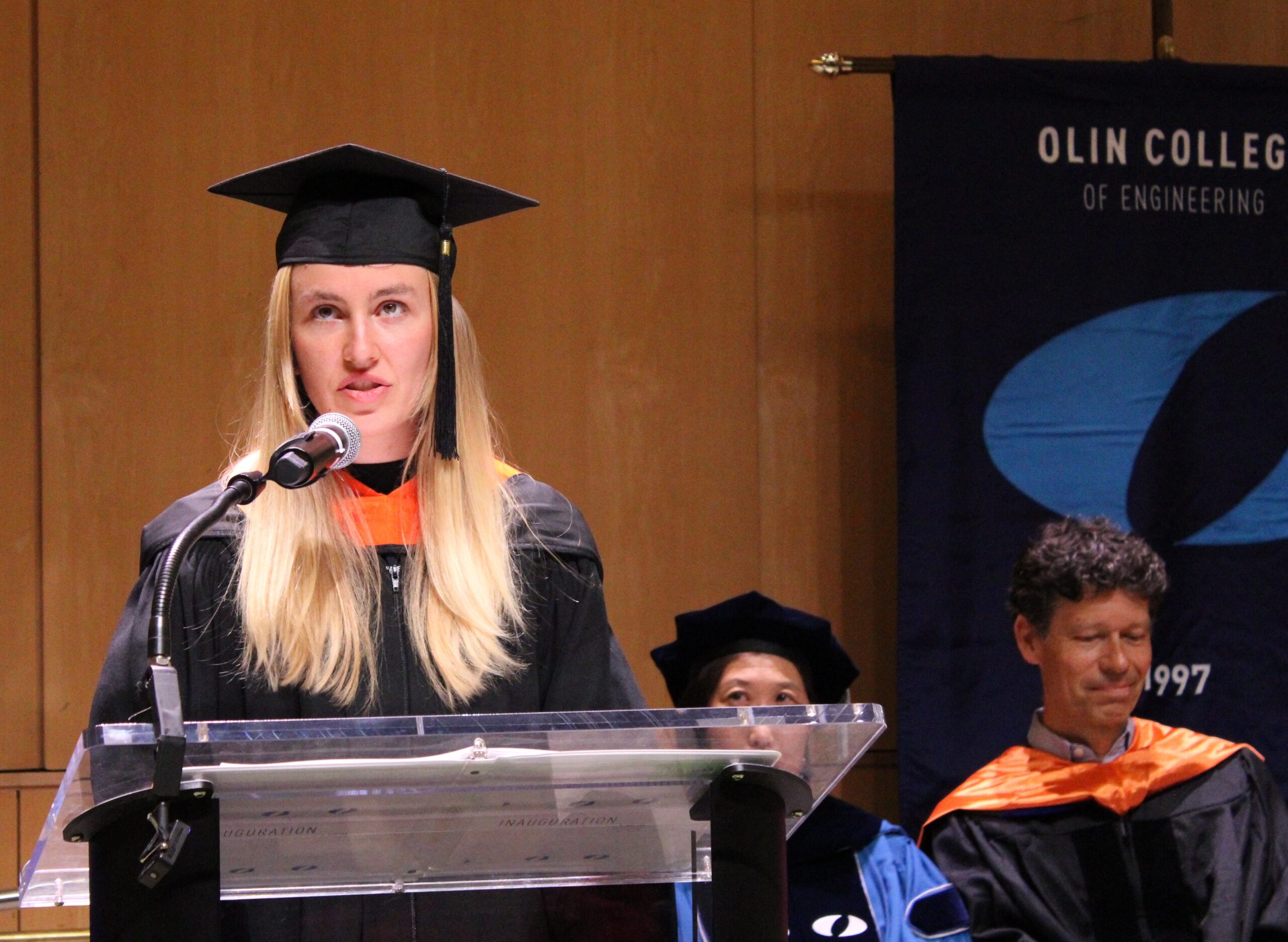
“Fifteen years ago, Alec Radford was a student here at Olin. He sat where you all sit today. He went on to be the first author of GPT-1, GPT-2 and CLIP. He contributed to DALL-E, Whisper, GPT-3 and GPT-4. He has re-rendered the path for us. Today, we have more power than ever to do the same and to do good for humankind. May we seize it.”
Casimir Wierzynski, Lee’s former colleague at Goldman Sachs, mused about another emerging technology that once generated safety concerns and high evaluations: “the internet.” Wierzynski, now engineering general manager at Microsoft, shared Lee’s ability to bring people together, calling it “a highly improbable constellation of singular souls.”
“To reach anyone on Earth, start with May and then go, at most, three hops on the social graph,” Wierzynski said. “Take that, Kevin Bacon.”
Olin’s founding was risky — as Professor Robert Martello explained, the school sent invitations to potential students before even securing a campus — but Wierzynski said Lee knows something about taking risks.
“May taught me that there are good risks and bad risks. A good risk is where you bring something distinctive: unusual knowledge, a remarkable team or an opportunity you’ve prepared yourself to recognize. Those are the shots you have to take,” he said. “A bad risk is one where the house has the advantage, or where you’re simply making the same bet as everybody else. Avoid those. And inaction, May would remind us, is not the absence of risk. It’s another choice with risks of its own.”
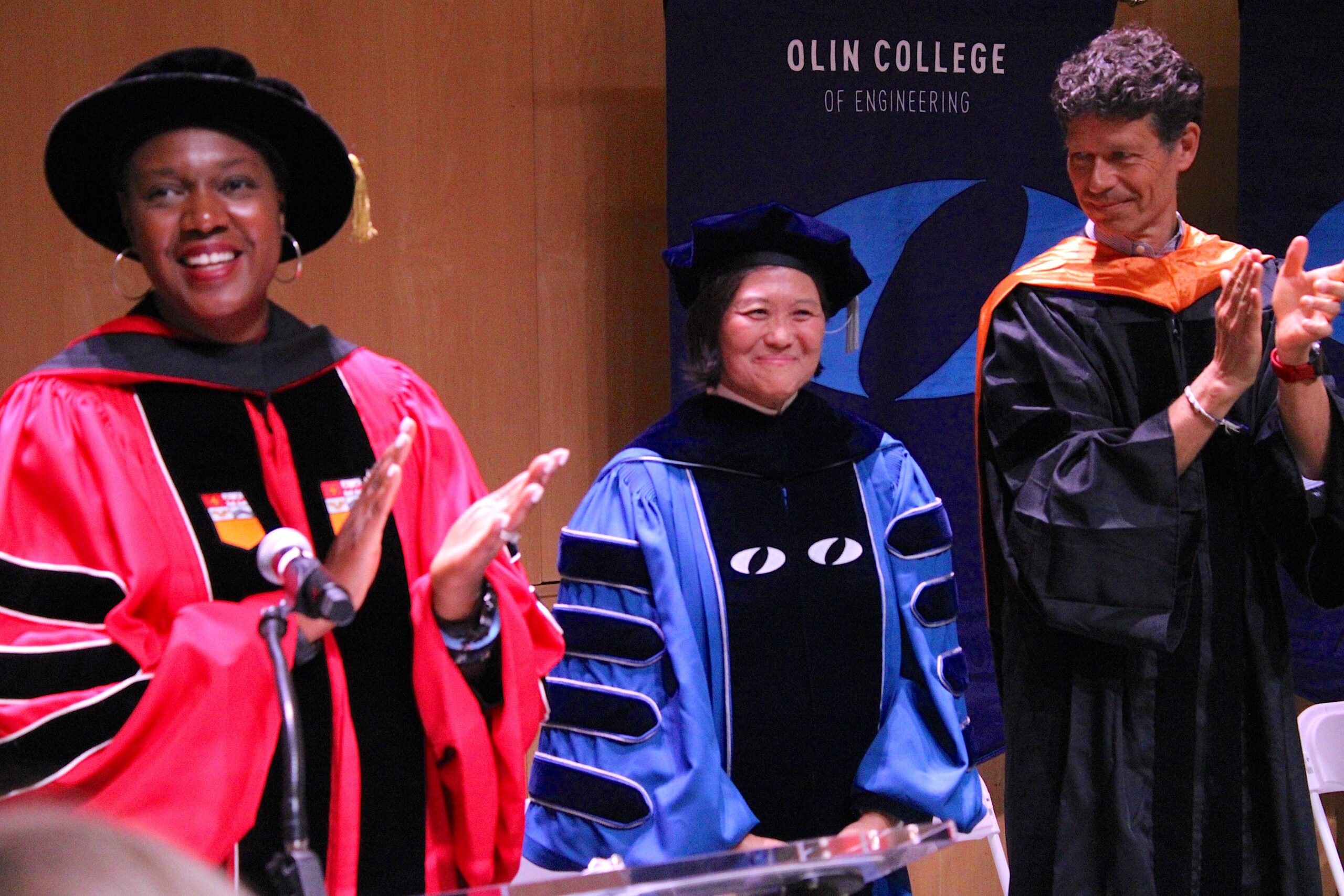
Lee’s parents moved from Hong Kong to Michigan as refugees, finding a home in an impoverished neighborhood in Detroit. Her family faced discrimination, but Lee said they instilled an important lesson: “speaking up matters.” Her husband, daughter, mother and other loved ones sat in the front row.
It’s in higher education where she said she “found my purpose.” She emphasized the importance of human-first learning, entrepreneurship and a willingness to fail, all ingrained in Olin’s curriculum.
Lee, who donned blue Olin socks in remembrance of founding board member Bill Norden, said Olin intentionally took a different educational path at its inception. Referring to Greek philosopher Epictetus, she spoke about “the purple thread, that small part which is bright and makes the rest of the white threads appear graceful and beautiful.”
Olin, she said, is that purple thread in higher ed.
“For Olin, it is a badge of honor to be non-conforming, not for the sake of being different. Rather, when we differ, it is in service of finding the best question to ask and answer. We choose our path, even knowing it diverges from the norm,” Lee said. “Embracing change and difference requires another characteristic, which Olin and Oliners possess in abundance: resilience. As I reflect on my own journey to Olin, I like to think I share a similar spirit.”