Town Candidates Share Priorities, Perspectives at Forum

April 2, 2026
• Candidates for this year’s three contested races descended on Broadmeadow Elementary School for the annual League of Women Voters candidates forum Monday night.
Ahead of the town election on Tuesday, April 14, candidates for office answered questions about the Pollard Middle School redesign, housing, local businesses and more.
Races for Select Board, School Committee and Planning Board are contested this year.
Three candidates are running for two, three-year seats on both the Select Board and the School Committee. Two candidates are running for one, five-year seat on the Planning Board.
Select Board
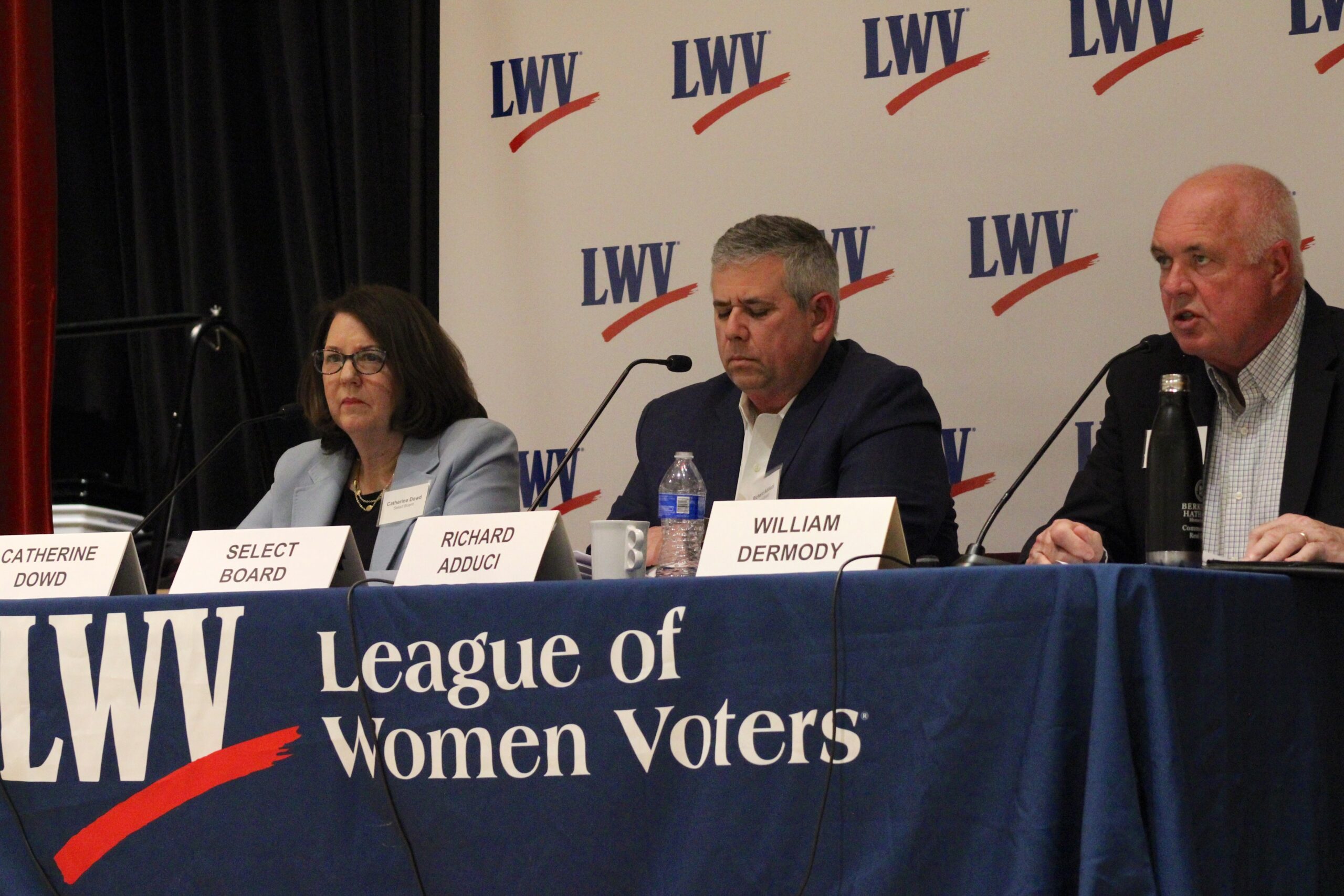
Cathy Dowd is seeking a second term on the Select Board, having previously served at Town Meeting. She taught history and government at Needham High School and has lived in Needham since 1996.
Rich Adduci moved to Needham in 2023 from Westborough. He runs his own technology and cybersecurity services business and is originally from Illinois.
Bill Dermody is a longtime Town Meeting member and member of the Memorial Park Trustees. He works as a Realtor and is a third-generation Needham resident.
The candidates were not asked directly about the Envision Needham Center project, though all three referenced the plans and their stance on them.
For Dermody, one key priority is supporting the local economy, which means maintaining a vibrant and accessible downtown. He hopes the project “minimizes disruption and preserves access and parking” and has previously stated his support for the four-lane plan.
In order to attract businesses and visitors to Needham, Dowd said it’s important to care for businesses already here: “We have to cherish them and make sure that they are doing well,” she said. She supports the current four-lane configuration for Envision, given the recent town polling and feedback.
Among his top priorities, Adduci said “we need to stop Envision” but ascertain which parts of the project may be useful, such as safety and sidewalk improvements. He said it’s also important to find ways to increase foot traffic.
On local business, Adduci and Dermody both discussed the need to streamline processes and provide better support for business owners. Adduci suggested hosting more outdoor events to spur activity, while Dermody said creating a checklist for businesses could ease the burden.
Dermody and Dowd both discussed expanding the commercial tax base by attracting more businesses that would strengthen the town’s fiscal position. Adduci said the town should exercise caution when it comes to spending, including on the Pollard project.
The candidates signaled support for more multi-family housing in Needham to further address concerns around affordability. Dowd said seniors have trouble downsizing, young families can’t afford to move to Needham and local employees can’t afford to live within a reasonable commuting distance.
“I think in this whole region, this lack of affordable housing is effectively killing the golden goose that we have economically,” Dowd said, “because why would businesses expand here or locate here if their people cannot afford to live here?”
Multi-family housing is needed, Adduci said, though he issued a warning.
“I think we have to be careful about that though, and thoughtful about the impacts it’s also going to have on our town,” Adduci said. “Higher density housing also drives infrastructure, school, service, pressures that need to account for, so we need to do that in a really balanced way.”
Dermody said he strongly supports multi-family and said accessory dwelling units may also help address the issue.
The candidates similarly spoke about Pollard, all agreeing on the current design submitted to the Massachusetts School Building Authority. Adduci said the town needs to look at cost because “that’s a step that we really haven’t taken yet,” though the town reviewed seven plans with their associated costs. The project could cost upwards of $336 million.
Dowd said a potential $60 million in state funding will be crucial, and the town shouldn’t delay.
Dermody, who said he toured the school over the weekend, said he recognized the need for lab space and arts space. Having performed on stages across Needham, Dermody said a new auditorium is crucial.
“I feel like it’s an auditorium for the town that happens to be at Pollard, so I think it will be a great addition,” Dermody said.
“Teaching has changed. Besides being in poor condition, the space does not fit today’s teaching needs,” he said.
Departing Select Board member Marianne Cooley advised her colleagues to share their views but, when a decision is reached, to “go forward collectively.” Dermody and Dowd agreed with the sentiment, with both stating the need for multiple perspectives, but Adduci did not. In his view, “there’s a lot of ruts in the road behind us” that suggest the board hasn’t listened to the community and that there “has been a problem” with the board working well together.
As someone whose “roots in the community run deep,” Dermody said he hopes to serve in a different way through the Select Board. He said he believes the town needs “thoughtful, balanced leadership.”
“Needham is a special place, not just because of our schools, businesses and neighborhoods, but because of the people who care enough to show up, ask questions and stay involved,” he said.
After hearing concerns about town management through neighbors and friends, Adduci decided to run. He referenced the MBTA Communities Act zoning, Envision and the Stephen Palmer Building as examples.
“I’m an independent thinker, and I’m here with no party affiliation,” he said. “My focus is simple: representing you.”
Dowd said she stands “for progress and pragmatism.” She highlighted the board’s accomplishments in the last three years, noting Needham Housing Authority funding, Needham Power Choice and quality of life improvements such as the library renovation.
“I truly believe that even for the hardest issues, when we have an open mind, gather the facts, listen to each other and assume the best intentions, we can move forward productively.”
School Committee
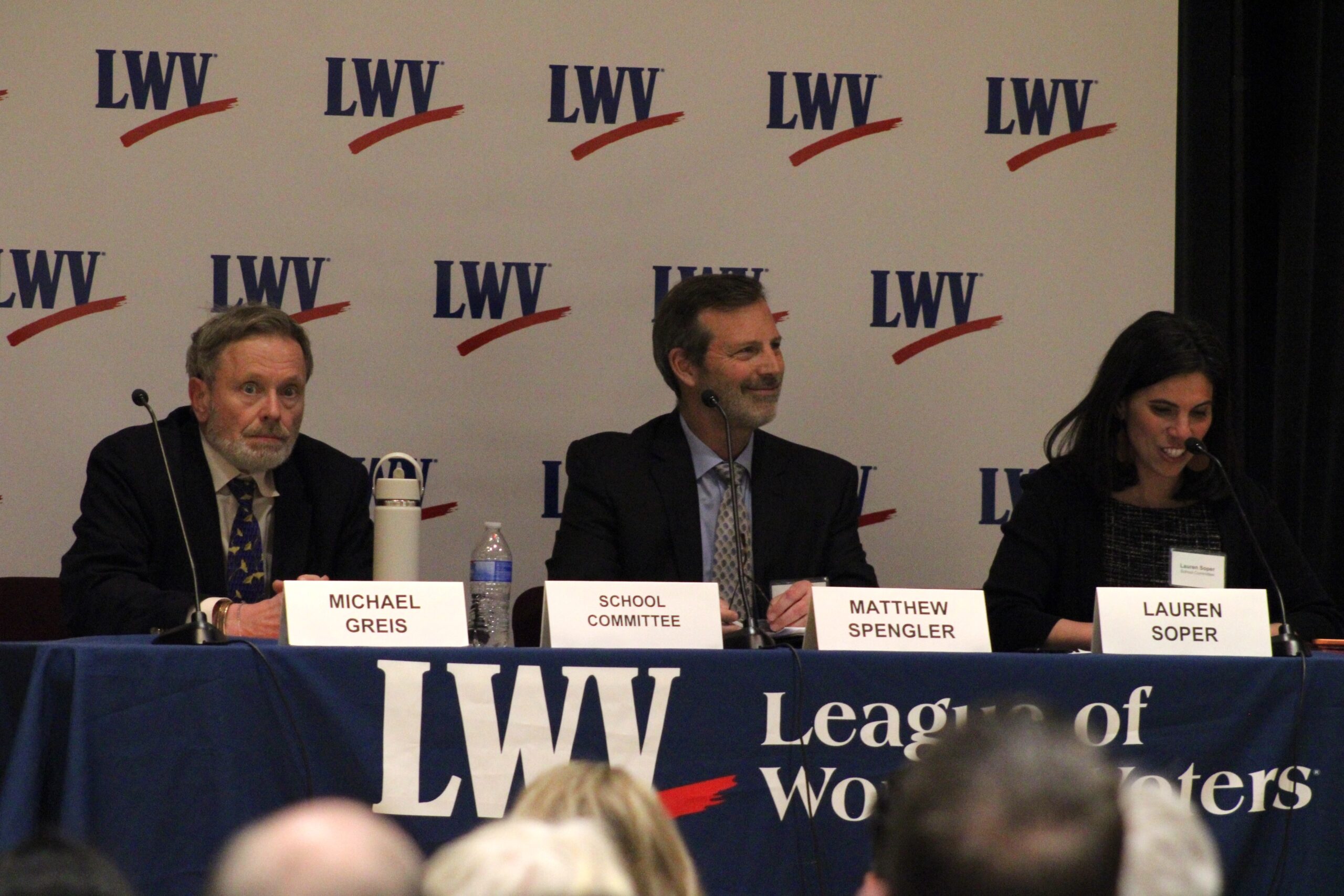
Matt Spengler has served on the committee for nine years and has spent 35 years working in K-12 education: first as a teacher and now as a superintendent. Spengler said his focus is on making sure school facilities support modern teaching and learning, policies support all learners and the district maintains its “hallmark” strong academics.
Michael Greis was first elected in 2005, prior to which he co-founded Citizens for Needham Schools. He also teaches at Bentley. Over the next few years, Greis said he hopes to maintain the district’s excellence, ensure student success beyond academics and secure support for the Pollard rebuild.
Lauren Soper works in wealth management and attended Needham Public Schools, where two of her five children are enrolled at Eliot Elementary School. Her top three priorities are auditing technology in schools, creating “consistent classrooms” and focusing on social-emotional learning.
All three support the Pollard redesign. Both Spengler and Soper discussed the need for community buy-in, with Spengler noting the building’s age and changing educational needs. Greis “emphatically” supports the plan, noting that its 1990 renovation was poorly run and that the town “learned from that terrible lesson.”
On Stephen Palmer, Soper said she hopes to determine the space’s best use for students, which could look like a rec center or additional space for science labs. She said there’s already enough housing to come.
Spengler, who sits on the Stephen Palmer Development Review Committee, said he’d like to consider both student experiential learning opportunities and workforce housing. Teachers can’t always afford to live in Needham, he said.
Stephen Palmer is under School Committee jurisdiction, he and Greis noted. Greis said the parcel is small, meaning it can’t become another school. If the committee doesn’t find a possible educational use for the building, Greis said they would turn it over to the Select Board.
Asked about artificial intelligence, Greis and Spengler see the technology as something schools must currently contend with, but in a responsible way.
“It is going to define the next generation in ways we don’t even know yet,” said Spengler, the parent of a Needham High School junior, “and so I believe it’s up to the public schools and our community to figure out how to use it well and equip our young people with the ability to use it well, when they choose to do so.”
“These tools are here, and students are using them,” Greis said, “so figuring out how the students will use them effectively and in an appropriate way is something that we have to do.”
In Soper’s estimation, the schools are already discussing AI with students, but perhaps they could better train teachers and parents around the dangers.
Training proved a recurring theme for Soper. She suggested addressing student mental health with training for administration and teachers, and she mentioned training in her opening remarks.
“There are problems that I want us to look at in the schools,” Soper said. “They are great, but we also need to see those widening achievement gaps, chronic absenteeism and persistent needs for training and development of special skills for our administration.”
The schools can tackle mental health through building design, Greis said — in the NHS redesign and in Pollard, they consider ways in which to create “positive, healthy learning environments.”
Spengler, whose mother is a clinical social worker, said data suggests “a dramatic increase in crisis for teenage mental health and wellness, and even younger than that,” and that multi-pronged interventions need to take place.
Spengler views his role on the committee as one determined to make “independent, sometimes tough decisions” with student experience in mind, he said.
“As I’ve grown up and moved from grade to grade as a member of the committee, I’ve tried to support what works, ask hard questions when needed and vote in ways that reflect the values to which we aspire,” he said.
At the core of NPS is the Portrait of a Needham Graduate, the mission that Greis called “our north star.” He marked his tenure through several key milestones, including the hiring of Superintendent Dan Gutekanst, repairing Newman Elementary and constructing Sunita Williams Elementary.
“Now I’m looking forward to what comes next: rebuilding a new Pollard and continuing to attract great teachers and staff,” he said.
Soper, who has experience “building communities in large organizations,” emphasized her goal to take Needham even further.
“We know our town can achieve the extraordinary… and we want to extend that achievement to all 5,500 students here,” she said. “I see a Needham where parents are consulted, teachers are empowered and students are reliably encouraged. Our future depends on it.”
Planning Board
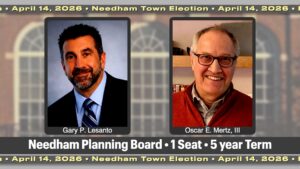
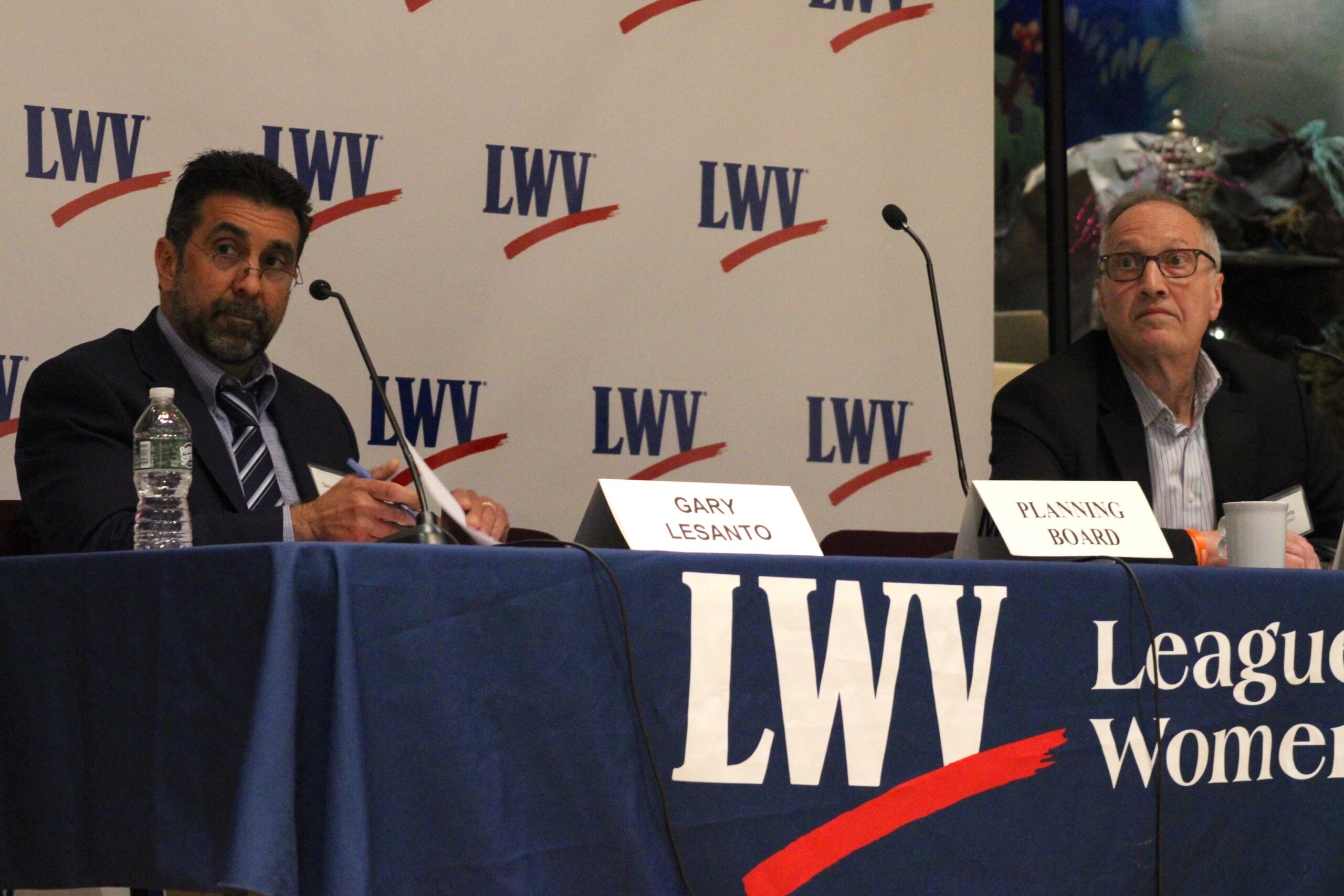
Gary Lesanto has worked in building development and property management for more than 30 years. He is a 25-year resident and previously served on the now-defunct Large House Committee from 2016-2019.
Oscar Mertz is a 40-plus-year architect and planner who has lived in Needham for more than 30 years. He previously ran for Planning Board in 2022.
They both appeared aligned on the Town Meeting citizens petition to convert 888 Great Plain Ave. — formerly Hillcrest Gardens — from residential zoning to business district zoning. Lesanto said, though he hasn’t viewed the full plans, the project seems to be a good fit. Mertz said it’s a “cherished property,” but the proposal seems appropriate and “encouraging.”
The candidates also converged on a key aspect: The fact that the property owner is not seeking to rezone the property through the Planning Board. Mertz said the board should have addressed it, and Lesanto said the developer is “kind of circumventing the Planning Board” by taking the petition route.
Also coming to Town Meeting is zoning changes that address large houses. Mertz served on the Large House Review Study Committee that put the proposal forward, after evaluating peer communities and holding public hearings.
“In the end, it will be up to Town Meeting,” Mertz said, “and I support realistic regulations that recognize both the need of residents to preserve the value of their property and the interest of neighbors to preserve the physical characteristics of their neighborhood.”
Lesanto said the current proposal is “embedded and riddled with a lot of unintended consequences” and would be “detrimental to the housing stock and stopping permits.” While on the former large house committee, Lesanto said he felt they “could go further,” and could now as well. He also took issue with the other towns the committee chose to evaluate.
Mertz responded that the committee chose not to assess Natick and Dedham because of their unique bylaw requirements in how they measure homes, as well as a perceived non-issue with large houses there.
In line with easing processes, Lesanto suggested relaxing permits for renovations that could help preserve “lower-end housing stock.” Working with Economic Development Director John Sisson could also help support local businesses, he said.
“Needham’s known for being a little bit difficult when it comes to new businesses getting set up and permitted to operate, and if those businesses want to expand as well,” Lesanto said.
Mertz’s view is to better plan for the future, or “put the ‘planning’ back in Planning Board.” That looks like collaborating with stakeholders, studying housing needs and growing the commercial base, he said.
If elected, Mertz said he hopes to use his “years of experience as a team player.” On the board, he would like to “establish a sense of trust,” he said.
“I want to be part of those conversations, working together as a community to help shape what we want for the future of Needham,” Mertz said.
One of Lesanto’s top priorities was to ensure residents’ voices are heard, a message he echoed in his closing remarks. Changes to Needham “should be thoughtful, gradual and grounded in the character of our community.”
“My approach is simple: Listen to residents, ask the right questions and make sure any change strengthens our neighborhoods, not overwhelms them,” Lesanto said.
The full forum is available on The Needham Channel’s website.
Bill Dermody serves as vice chair of the Needham Community Television Development Corporation, which oversees Needham Local and The Needham Channel. He was not involved in the writing or editing of this article.
Michael Greis serves as chair of the Needham Community Television Development Corporation. He was also not involved in the writing or editing of this article.