School Committee Candidates Talk Pollard, School Achievement

March 23, 2026
• Three candidates are vying for two seats on the Needham School Committee in the April election.
Many upcoming projects and ongoing issues center on the Needham Public Schools: the Pollard Middle School rebuild, post-pandemic achievement gaps, chronic absenteeism and balancing a budget, to name a few.
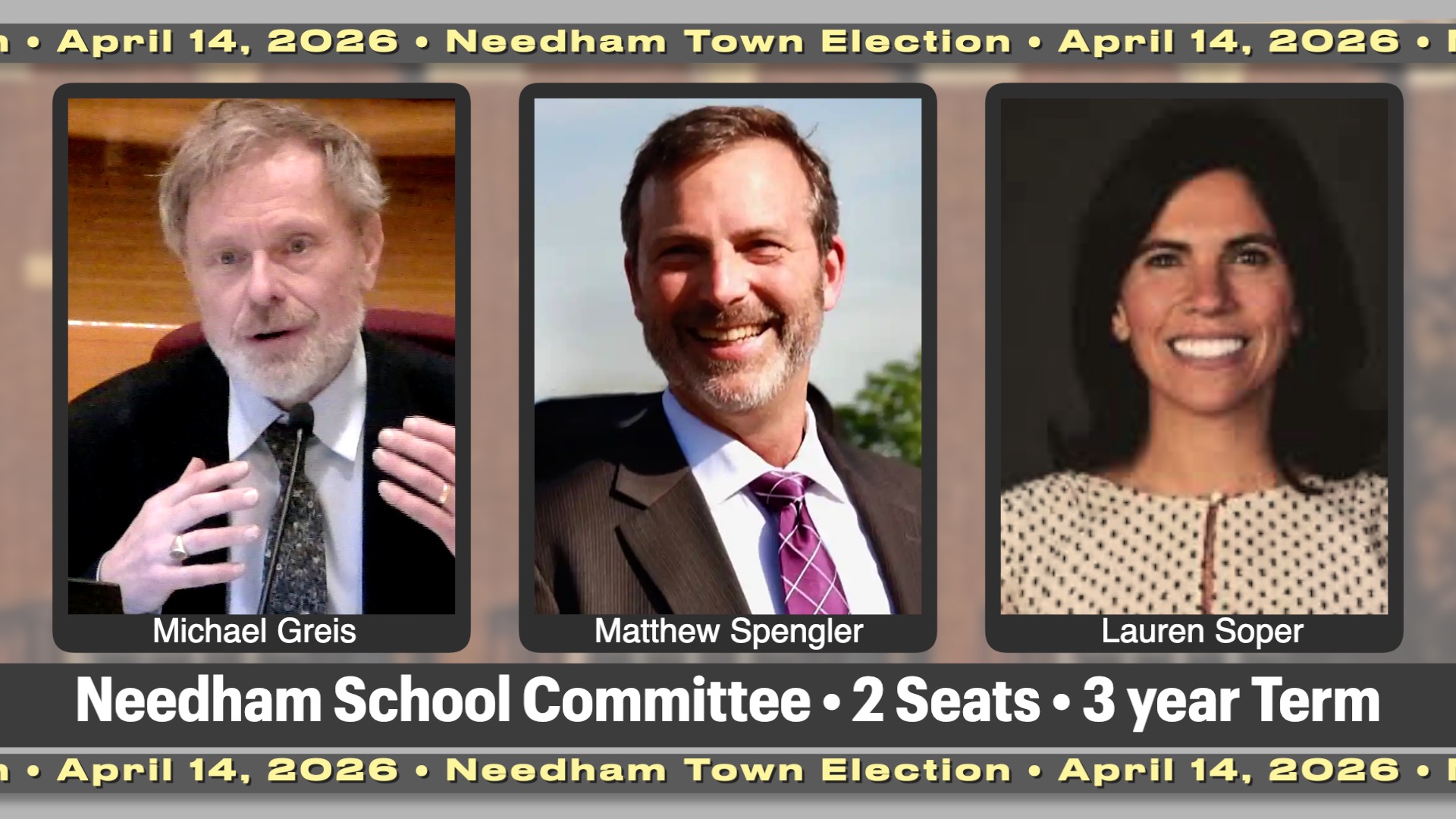
In the lead-up to next month’s election, the three candidates running for School Committee shared their perspectives and experience. Incumbents Michael Greis and Matt Spengler are running for reelection, and newcomer Lauren Soper is challenging them. The term is three years.
The election is Tuesday, April 14.
Greis, the longest serving member of the committee, was first elected in 2005. Over those 21 years, he has overseen several building projects and chaired the subcommittee that hired Superintendent Dan Gutekanst, which he said is “probably the best thing I ever did.”
While Greis was chair, the committee finished and opened Sunita Williams Elementary in 2019. Greis said finding a place for the school proved challenging, which they faced again with Pollard. He said his tenure on the board is an asset.
“I bring all that institutional knowledge,” Greis said. “I love new ideas, and I bring lots of them. What I do is I look at anything that comes to me that maybe has been tried before, and say, ‘O.K. so if it didn’t work, what’s different?’”
The Pollard project recently received approval from the Massachusetts School Building Authority for its preferred schematic report. The town now enters into its design stage.
Creating something new and maintaining outstanding schools is important to Spengler. His own children attended Pollard, and since the building’s construction in 1958, our understanding of how adolescents best learn has changed, he said. That looks like flexibility, spaces for collaboration, accommodations and more, he said.
However, Spengler said the committee and town must ask difficult questions about the cost of the project and its purpose. The estimated cost is around $336 million right now. The goal is to bring a plan to the community that “is educationally sound and financially responsible,” he said.
“My personal hope is that the community will support the plan that’s being put out there,” said Spengler, who seeks a fourth term, “but understand that there are a lot of reasonable and very hard questions that need to be continued to be discussed and answered.”
Soper, the parent of five children, said engagement is key. The Pollard project will require buy-in from the community, and the committee should be finding more opportunities to inform and solicit feedback, Soper said.
Soper said she agrees with the plan to keep Pollard on its current lot, as opposed to moving into DeFazio Field. In speaking with residents, most seem aligned on the plan, but she feels the committee should be engaging with community members every day, “because this is a substantial ask.”
“I think we all agree it’s go-time,” Soper said, “and what we should be focused on now is engagement and transparency, radical transparency, so that when it comes to a vote, we’re getting the votes that we need to go forward.”
As someone in the wealth management industry, Soper is intent on closing achievement gaps by finding data points and making incremental change. She compared it to bone broth — instead of throwing out a chicken carcass, you could heat it up, add some ingredients and create something substantial.
For Soper, achievement is more than math and science. It’s also about social-emotional learning and the ways schools model core values, she said. When it comes to chronic absenteeism, the district’s current intervention strategies seem to be “just layering on top of a symptom,” she said. Understanding systemic issues would lead to better solutions, she added.
“A lot of parents were talking to me about their children with additional needs, mental health, behavioral incidents… And to me, that comes down to achievement around social-emotional learning,” she said. “We can treat it like data. Sometimes people call it the soft skills, but to me, it’s very much hard skills.”
Greis views achievement through a health lens — providing students the best learning experience is “inextricably tied” to mental well-being, he said. In renovating Needham High School, the committee prioritized spaces for gathering and collaboration, which ties into wellness, he said.
His “elevator pitch” for NPS is “we are preparing the next generation of citizens,” he said.
“It’s in everything we do,” he said. “Yes, it’s in the counseling resources you have. Yes, it’s in the nursing resources you have. Yes, it’s in thinking about nutrition and food services and transportation and co-curriculars and stuff. But it’s literally in everything.”
Equity is at the center of Spengler’s career in education. He is the founder and executive director of Blueprint Schools Network, which aims to raise math scores across the country through classes and targeted math tutoring.
Through that work, he pays close attention to students who are low-income, students of color and English language learners, among others, to better understand how to ensure every student is successful in Needham. He said he has seen “real growth” in terms of helping kids who fall behind, but there’s room for improvement.
“There’s no excuse for not doing it anywhere else with our resources,” he said, “and so there’s no reason, that I can see, why as a community and a school committee working with outstanding administrators that we can’t close that opportunity gap in learning and opportunity for all students.”
A former teacher himself — he began teaching English in Los Angeles amid an emergency teacher shortage — Spengler found the profession difficult but intensely rewarding. He also founded a small high school in Oakland about 25 years ago.
In prioritizing student voices, Spengler first proposed having a student representative on the committee, which he has deemed a success. He also feels proud of pushing back against an old policy wherein students behind on lunch payments received a different meal than their peers. And in analyzing data, he opposed the accelerated math program in middle school, which has since been removed.
“For better or for worse, I’ve probably voted no more than any other committee member on different policies or different initiatives when I think that there are potential equity issues, or we need more research, or need to look at the data again,” Spengler said. “We can have good, strong, civil discourse that is respectful and talks about the issues. And I think, frankly, it’s important for committees to have disagreement and not just rubber stamp everything that comes onto our plate.”
Soper hears from parents what they call “head-nodding syndrome,” where committee members fail to challenge each other. As a challenger, she feels comfortable asking questions, diving into topics and engaging with energy and passion.
Soper attended the schools herself — she went to High Rock when it was an elementary school — and now has two of five children in the schools, with the other three entering kindergarten in the next couple years. With her children, she said she practices bravery, whether it be hosting family talent shows or trying something new.
“I think that so much change can happen when you bring in new people,” she said. “That first six to 18 months can be incredibly rewarding when you have that intense focus on understanding.”
Greis co-founded Green Needham, the sustainability advocacy organization, and has been involved in a number of town committees, including the Permanent Public Building Committee and Climate Action Committee. He’s also part of the Great Hall Performance Foundation, which hosts concerts at Town Hall, and is a Town Meeting member.
Also a finance lecturer at Bentley University, Greis said his love for education hasn’t faded in his two decades on the committee.
“I am very involved in this town. I love what I do,” he said. “People are making a decision. I want them to know what I’ve accomplished and that I deeply care about this, and basically, I want their vote so I can keep doing what I love doing.”
The Needham League of Women Voters will hold a candidates forum for School Committee, Select Board and Planning Board on Monday, March 30 at 7:30 p.m. at Broadmeadow School and on Zoom.
Michael Greis is chair of the Needham Community Television Development Corporation, which oversees Needham Local and the Needham Channel. He was not involved in the reporting or editing of this story.