Planning Board Candidates Diverge on Parking, Housing

March 27, 2026
• Gary Lesanto and Oscar Mertz discussed their positions on town matters during a virtual debate on Wednesday.
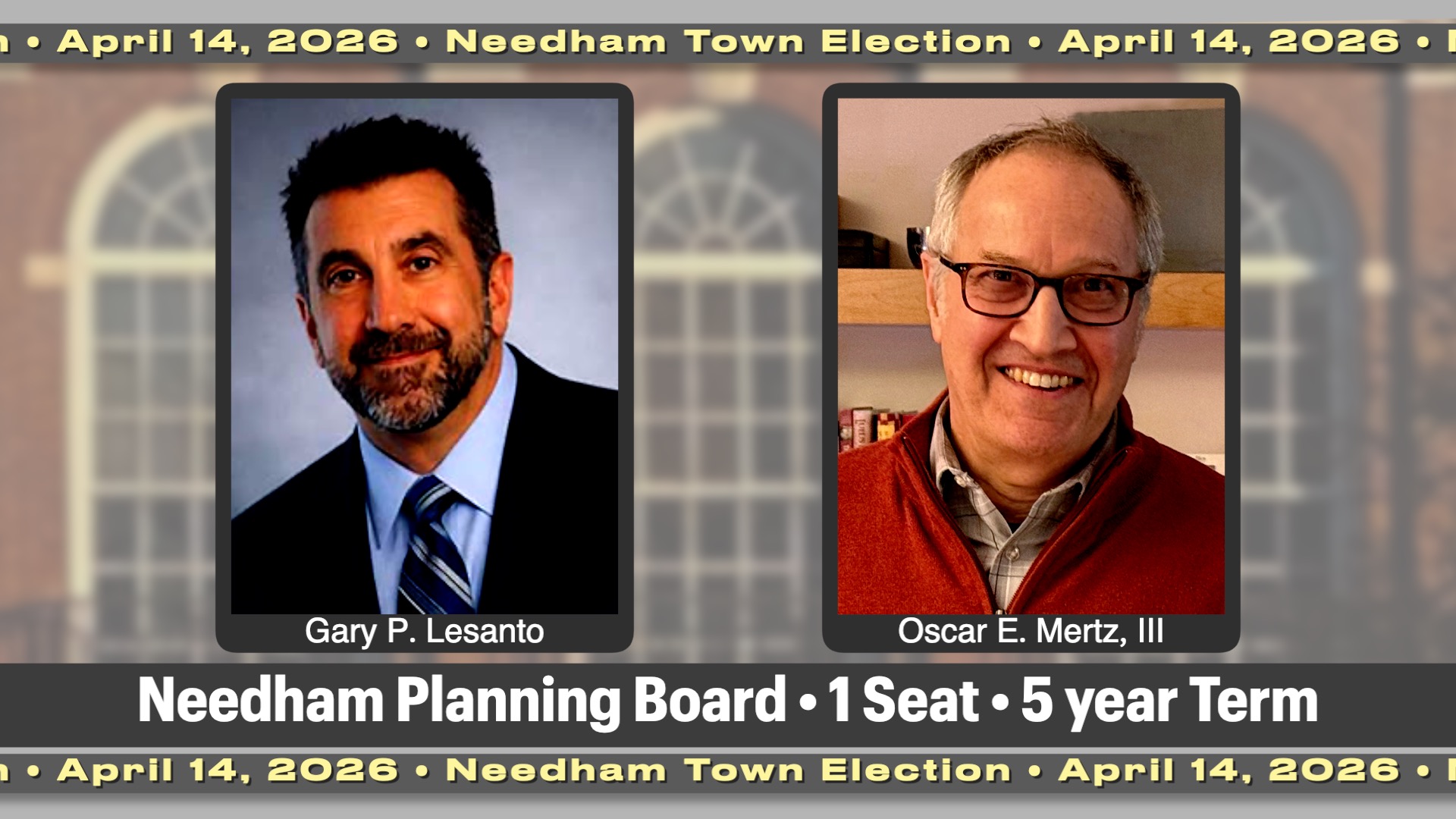
In the race for one five-year seat on the Planning Board, a builder and an architect exchanged ideas and perspectives at a virtual debate through the Charles River Regional Chamber.
Gary Lesanto, a semi-retired builder and developer, and Oscar Mertz, an architect and planner, are running for the position currently held by Natasha Espada. The election is Tuesday, April 14.
Lesanto and Mertz found consensus on few topics. They agreed that the future of the Muzi site should be a mixed-use development that minimizes negative impacts such as parking and traffic, and they both expressed apprehension about the estimated 500 housing units the owner wants at the site. During the debate, they also suggested streamlining processes for businesses, echoing similar sentiments at the chamber’s Select Board debate last week.
Otherwise, the two candidates drew sharp contrasts against each other.
Housing
When asked about Needham’s housing and growth policies, Lesanto highlighted the 2025 referendum, in which voters overturned one MBTA Communities Act zoning plan in favor of a less drastic one. Through overlays and friendly 40Bs — affordable housing projects in Massachusetts wherein developers cooperate with the town on specifics — the town can add density, Lesanto said.
“Prior to MBTA [Communities], I thought Needham has done a great job with housing, actually,” Lesanto said.
Mertz disagreed, stating he feels the town is “by no means serving all the housing needs we have.” That includes seniors, local employees and young people, he said. The Base Plan, the adopted zoning plan under the MBTA Communities Act, is a first step, he added.
“We need to keep trying to be creative and thoughtful and now we can do that together as a community, decide on where we want to see all this kind of growth across town, as it’s going to take decades, but it’s thinking ahead,” Mertz said.
Lesanto said he doesn’t view the Base Plan as a starting point but rather “where we are.” The town can maintain more control that way, he said.
“I think my opponent wasn’t hearing the Needham residents loud and clear when he was a proponent for ‘Yes,’ and he’s not hearing them now that the Base Plan was accepted,” he said.
In talking with business owners, Lesanto said they want density but don’t need affordable housing for their employees.
Mertz, however, said workers are commuting long distances when they could be living in apartments or accessory dwelling units. Legislating units per acre is a bad idea, Mertz said.
The market should dictate the number of units, he said, and their focus should be on “gentle density.”
“It’s all about more choices, more types of housing to give us diversity of choice and give us a way of spreading out that gentle density,” Mertz said, “which is a key thing that we can do with a lot of the land that’s already developed on small lots.”
Parking
Newton recently reduced and eliminated parking minimums, meaning developments can forgo special permitting. Moderator Max Woolf questioned where Mertz and Lesanto fall on that issue.
Lesanto said he is “pro parking” and believes density and parking go hand-in-hand. He said he’s interested in reducing parking restrictions but also in adding new spaces “as long as it fits into the scale and character of the neighborhood in which it’s being applied.”
For Mertz, “parking is crucial.” But town surveys indicate the town has enough parking spaces, so the town should act as “better stewards” of existing parking lots, such as the ones at Walgreens and CVS, he said. He suggested the use of surge rates at meters to encourage drivers to park further from main thoroughfares to better control areas, Mertz said.
Lesanto plainly disagreed, stating the town only has adequate parking for its current density. Spaces need to be added “in a thoughtful, gradual way,” he said.
“If we add density in any shape or form in the downtown, and it doesn’t provide its own adequate parking, then it’s going to be a burden on what we already have for our infrastructure in that regard,” Lesanto said.
Developers strive to maximize the number of units, Lesanto said, and he feels loosening minimums doesn’t guarantee affordable units.
Mertz countered that claim, stating the market decides and individual builders decide what’s needed. Both entities should have “the ability to drive what that traffic needs to be,” Mertz said.
Relaxing parking rates for development encourages more production, but overlay zoning in the downtown is an obstacle, he said. Reducing the parking requirement would allow for more flexibility on how many units can go on a lot, which in turn could incentivize smaller units, lower rents and more options, he added.
“We know that it’s a big burden on development,” Mertz said of parking, “so we have to be careful to figure out how we can do it strategically and make it as efficient and shared in use as much as possible.”
Teardowns
Lesanto — a former member of the Large House Study Committee in 2016-2019 — said he’s “a little disappointed” in the Town Meeting zoning articles regarding teardowns. The proposals, in his eyes, have “a lot of unintended consequences” and “targets and restricts our [Single Residence B] districts unproportionally and in the wrong areas.”
The proposed zoning changes in the warrant affect SRB districts.
Instead, Lesanto said they should look to make policy changes around even bigger homes, which would address better address the issue without hurting others. The plans hurt floor layouts, permits, and development, he added.
Lesanto called it “a missed opportunity” and that it “doesn’t have to be so consequential and detrimental to the market and our growth plan.”
Mertz sits on the Large House Review Study Committee, which put the proposals forward. Needham allows larger-size homes than surrounding communities, he said, but it’s more so about the appropriateness of the home on the lot rather than the home size alone.
“There are demands for these larger houses. We know there’s a market demand for some of the houses that have a few more bedrooms, but there’s also a lot that’s getting built that’s just very big,” Mertz said. “And I think the adjustments that we have looked at are also addressing the actual sizes of houses that are getting built.”
The candidates disagreed on the term “slight reduction” — Mertz said the plans won’t make changes to side yard setbacks and will still allow for flexibility on the ground floor. Lesanto responded to the latter directly, adding that the reduction is “massive.”
“Oscar talks about flexibility in the first floor, but then out of the other tongue, his actual proposal reduces lot coverage by 3% or nearly 300 square feet on the first floor,” Lesanto said, “which will hamper first floor layouts, as well as hamper designs for the second floor because of the constriction on the first floor.”
Experience
Mertz previously ran for Planning Board in 2022. He’s lived in Needham for 33 years and has worked as an architect and planner for more than 40 years. Through his career, Mertz said he’s learned how to identify needs in a project, collaborate and “reach solutions that are benefiting this town.”
“We have a lot of very passionate people in town, and it is all about talking and listening and working together,” Mertz said. “I think that what I believe there is an agenda, and the agenda is what’s best for Needham, and we have to trust that the people who live in town, work in town, are doing their jobs as elected or as volunteers or as people who want to be engaged, and we have to respect that.”
Lesanto has lived in Needham for 25 years and has worked as a builder, developer and property manager for about 30 years. In those three decades, he said he’s watched development start on paper and come to life.
“What I bring to this race is practical experience of a skill set built over more than 30 years in building development and property management,” Lesanto said. “I understand the process because I’ve lived it, from zoning regulations and special permits to how projects move from an idea on paper to something built in the real world. And what I’ve learned is that what looks good on paper can feel very different once it’s actually built. And once it’s built, there’s no return policy.”
The League of Women Voters will host a candidates forum on Monday at 7 p.m. at Broadmeadow Elementary School and via Zoom.