Pollard Passes, Override Vote to Appear on Ballot

October 21, 2026
• The Special Town Meeting decision puts the project in the hands of Needham voters, who will decide on its ultimate fate at the ballot box next month.
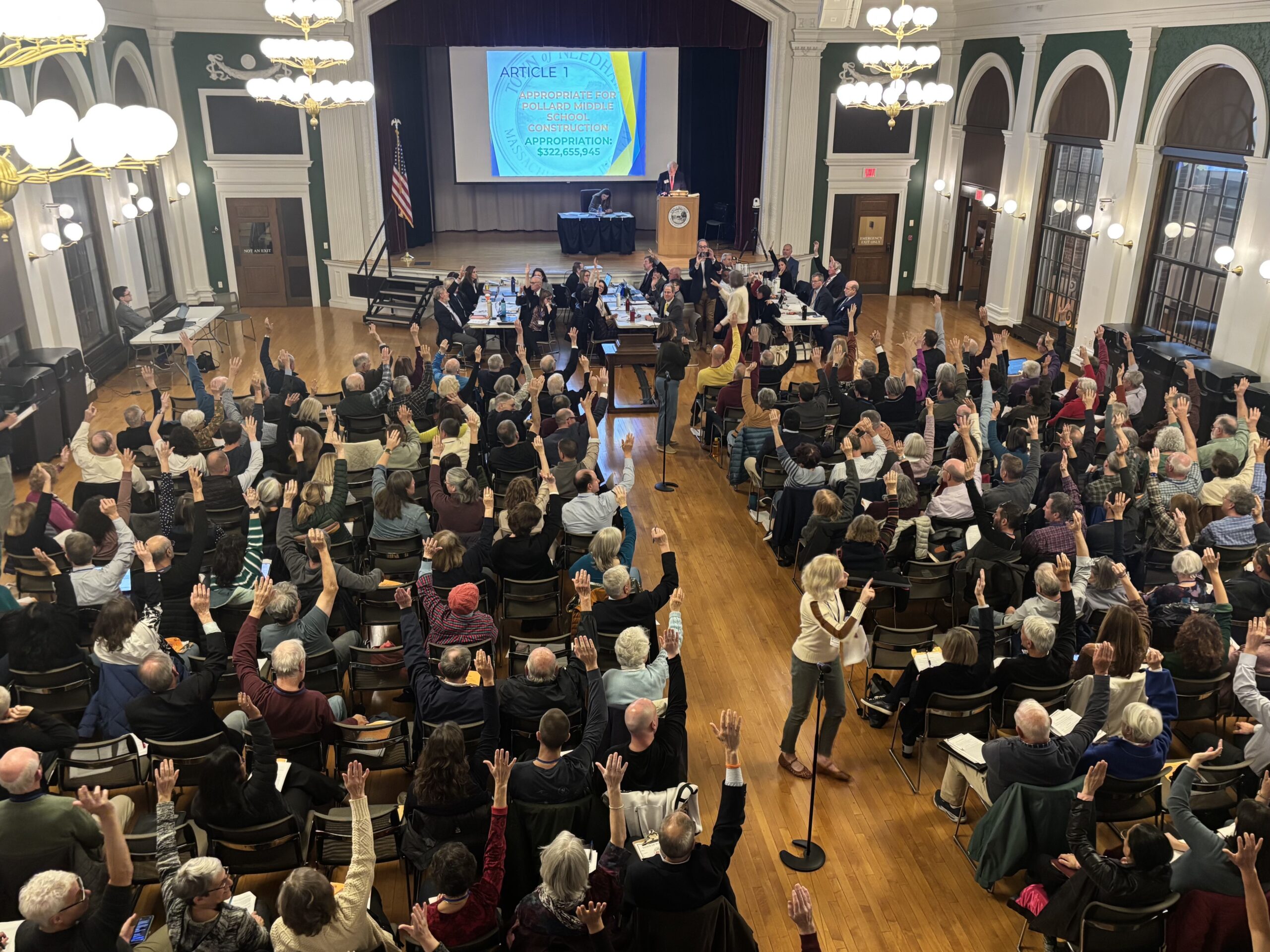
In a decisive 207-21 vote, Special Town Meeting on Monday approved $322,655,945 for the construction of a new Pollard Middle School, one of the town’s most costly projects to date. Come Nov. 3, voters will decide whether to support a debt override exclusion that would enable the project.
For several speakers, the need for the renovation outweighed its hefty price tag, though the expense doesn’t make it any easier. The project would be funded through borrowing, meaning taxpayers will foot the bill over a 35-year period.
“The size of this tax increase makes me wonder if I’m ever going to make another 401k payment. Still, I’m voting yes,” Town Meeting member Brian Keaney said. “I’m voting enthusiastically yes, and I ask everyone else here to do the same.”
Keaney, who rents in Needham with his family, called moving to town “hands down the absolute worst financial decision I’ve ever made in my entire life.” But he moved for the Needham Public Schools, and “if the schools were worth making sacrifices to get here, they’re absolutely worth making sacrifices to sustain them,” he said.
The town released a digital tax calculator to assist residents in understanding their share of the Pollard project. For the average single-family home, taxes peak at a $2,065 increase in FY 2034, with an average annual increase of about $1,167, according to town estimates.
Longtime Town Meeting member Lois Sockol also pondered how seniors may handle the tax increases related to the project. But seeing the design renderings, she said, excited her. Sockol, who herself is in her 90s, worked as a teacher in Newton and said the new Pollard will provide “more than adequate space” for middle schoolers.
“I have struggled because of the financial burden it means to people in my age group. But you know what? I know that all of us in my age group, too, know that the hope is in the future,” Sockol said. “And what is the future but our children?”
The two-phased project would begin in mid-2028 and combine grades 6, 7 and 8 under one roof. That would leave High Rock School, which currently houses sixth graders, vacant ahead of potential renovations at Mitchell Elementary School.
At an estimated $979 per square foot, the project is in line with other school building projects in the state, School Committee Chair Alisa Skatrud said. If the override fails to pass, Skatrud said the town would likely have had to forfeit an $80 million reimbursement from the Massachusetts School Building Authority, and re-submitting for funding would take several years. Reduced renovations or base repairs to the existing building would still require a debt override, she added.
Given the steep rise in taxes associated with the project, voters townwide will need to decide on Nov. 3 whether to override Proposition 2 1/2, which would allow the town to exceed its 2.5% annual tax increase. In order for the project to move forward, the override would need to pass. If it doesn’t, the town could hold a second vote on the same project in order to remain eligible for the MSBA reimbursement. The override question will be the 10th ballot question.
The Finance Committee previously split 5-4 in favor of the plan, with many signaling hesitance with the anticipated tax burden on residents. Chair Barry Coffman, who supported the article, called it “a big ask, a huge ask” in his remarks at Town Meeting.
Over the last five years, construction costs have sharply risen, Coffman said, and costs will only continue to rise should the town delay any further. Still, looking back, he said the town perhaps should have better prepared for this expense.
“In the ideal world, knowing this project was on the horizon several years ago, we — and I am referring to all of us here, the Select Board, town management, Town Meeting, along with our committee — could have worked hard to build up more reserves and our debt stabilization fund to mitigate some of the required borrowing,” Coffman said.
The town’s debt stabilization fund currently holds $3 million, but because the target is 5% of total general fund revenues or two years of general fund debt service within the levy limit, it should be closer to $13 or $14 million, Town Meeting member Adam Cole said. Coffman said Fin Comm is working with the Select Board to alter its current policy to reserve more funds for future debt service.
While he voted favorably, Cole implored the town to proactively consider future projects and their impact.
“The amount of money that we are looking at borrowing is tremendous… and feels like in some way we’ve failed those citizens who have fixed incomes and limited budgets in order to handle these tax increases,” Cole said.
“The taxpayers, the townspeople, we do not have unlimited funds to do everything we can, and we really do need to get serious about what we are going to prioritize so that this remains an affordable town for others,” he added.
For Town Meeting member Doug Fox, the decision on the project should go to the ballot.
“Even if you have some reason you’re personally against this or you don’t like a little thing or that, voting no is selfish because you’re prohibiting the town from deciding whether they want this,” Fox said. “Let’s give them the right to vote for it.”
Others noted the need for an improved auditorium, given perceived deficiencies at Needham High School’s theater space and that at Newman Elementary School, where many groups perform.
After a voice vote, Moderator Michael Fee called for a hand count. The project required a two-thirds majority for passage.
On Monday, Town Meeting also voted to appropriate the remaining $45,000 in feasibility funding for the project toward next steps. Town Meeting previously appropriated $2.75 million.
Town Meeting approved the 12 other articles, including an amended tree preservation bylaw, zoning articles related to large houses and zoning for a local historic district for 178 South St., once home to the Zirngiebel-Wyeth family.