Historians Seek Preservation for Joshua Lewis House

March 9, 2026
• The N.C. Wyeth Research Foundation and Reading Libraries, who owns the building, agreed to pursue protections to ensure the historic property is not demolished.
When the “for sale” sign went up, Gloria Greis said she was concerned. As executive director of the Needham History Center and Museum, she feared one of the town’s most historically significant homes, located at 178 South St., may fall into a developer’s lap and no longer exist.
Greis posted a plea on Facebook last month in an effort to generate awareness around the home and her hopes to find “a preservation-minded buyer.” She wrote: “The house recently went back on the market and is now in danger of becoming a tear-down. Time is critical!”
Now, it seems that fear has, tentatively, subsided. The N.C. Wyeth Research Foundation and Reading Libraries recently decided to pursue a single-family local historic district for the property, which would protect it from being torn down.
Instituting such zoning requires a two-thirds vote at Town Meeting. Greis will discuss next steps at the Select Board meeting tomorrow night.
“It’s the strongest current preservation mechanism we have,” Greis said in an interview. “I would say it’s the most historic house in town, and I think people appreciate that and have been very supportive of us keeping the preservation issue alive.”
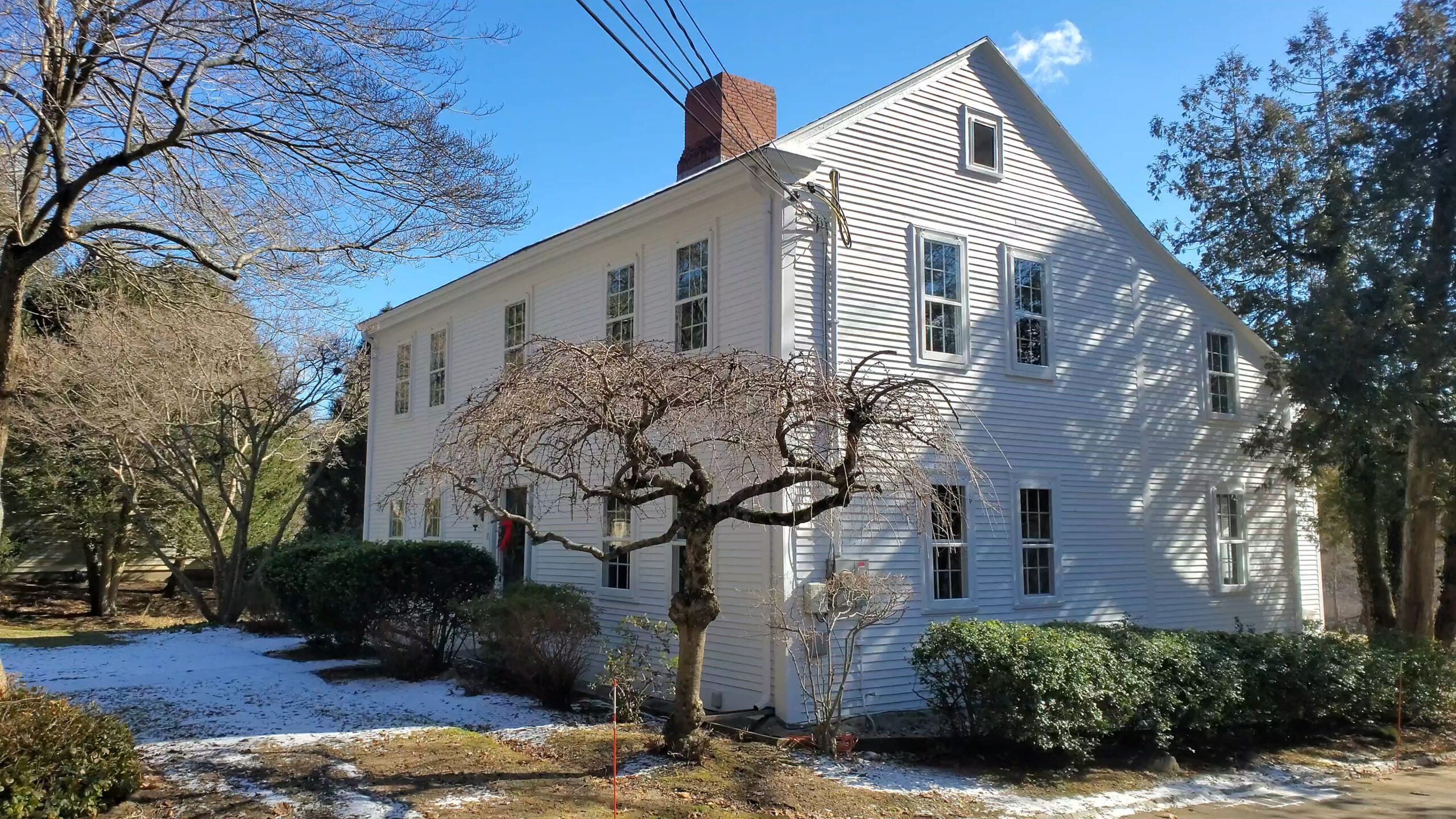
The Joshua Lewis House, also called the Zirngiebel-Wyeth House, was built in 1776 and became the home of several prominent Needham figures, including Denys Zirngiebel, who pioneered the giant Swiss pansy, and as well as several artists such as NC Wyeth, a descendent of Zirngiebel’s who featured the house in his work.
The over 5,000-square-foot home is listed on the Needham Historical Commission’s inventory of historic properties, meaning it qualifies for a six-month demolition delay under the town bylaws. Greis is a member of the commission.
It went on the market in 2024 but has failed to find a buyer. Initially listed for $2.7 million, it was last listed at $1.95 million.
In a memo to Town Manager Katie King, Veronika Carlson, president of the N.C. Wyeth Research Foundation and Reading Libraries, wrote of the organization’s intention to pursue a local historic district for the property.
“It is with great reluctance that the foundation has found it necessary to sell this property,” she wrote in part, “however it strongly desires that it be preserved not only for its historical significance but the continuation of the Wyeth Family legacy.”
The foundation aims to use funds from the sale to finance its other ventures, according to Greis and the Needham Observer. The foundation manages other former Wyeth properties, including one in Maine.
Carlson could not be reached by phone or email before publication.
Greis said the history center and the foundation have considered the Needham property’s future for several months, but they had not aligned on a shared vision until recently. Linda Bean, the granddaughter of L.L. Bean who founded the Wyeth Foundation, planned to transform the South Street home into a research library, but she died before the plans materialized.
The history center was unable to purchase the property themselves, and pursuing grant funding would mean additional financial investment on the center’s part to run the facility and staff it, Greis added.
The significance of the property — and the town’s interest in maintaining it — became evident, she said.
“I think they came to realize that this house really was very important to the town,” Greis said of the foundation. “We’ve gotten a lot of support for the efforts to preserve it, and people were very much interested in seeing the house preserved.”
Bylaws creating single-house local historic districts were approved at Town Meeting in May 2024.
Greis said they hope to bring forward the Joshua Lewis House zoning to Town Meeting this fall. If passed, the home must retain its publicly-visible exterior, but anything within can be changed or modernized. The bylaw excludes paint color, driveways and walkways and similar tweaks. In the event damage to the home caused by a disaster, reconstruction must begin within a year, according to the bylaw.
In an ideal scenario, Greis said she would like to see a family live in the residence and maintain much of its historic interior. Some of its less usable features — she pointed to a steep, narrow staircase — may be replaced, but other parts, such as the hearth, add to its historic character, she said.
The property contains five bedrooms and four bathrooms, with modern elements such as an elevator, an accessory dwelling unit and a detached garage.
Potential local historic district zoning is still several months away, but for now, Greis and other local history lovers are breathing a sigh of relief.
“We’re incredibly pleased, because this will put durable protection on the house,” she said.