‘It’s Like Breathing’: Local Religious Institutions Recognize, Honor LGBTQ Members

June 23, 2025
• During Pride Month, leaders in Needham’s religious community reflect on how they celebrate and advocate for LGBTQ people.
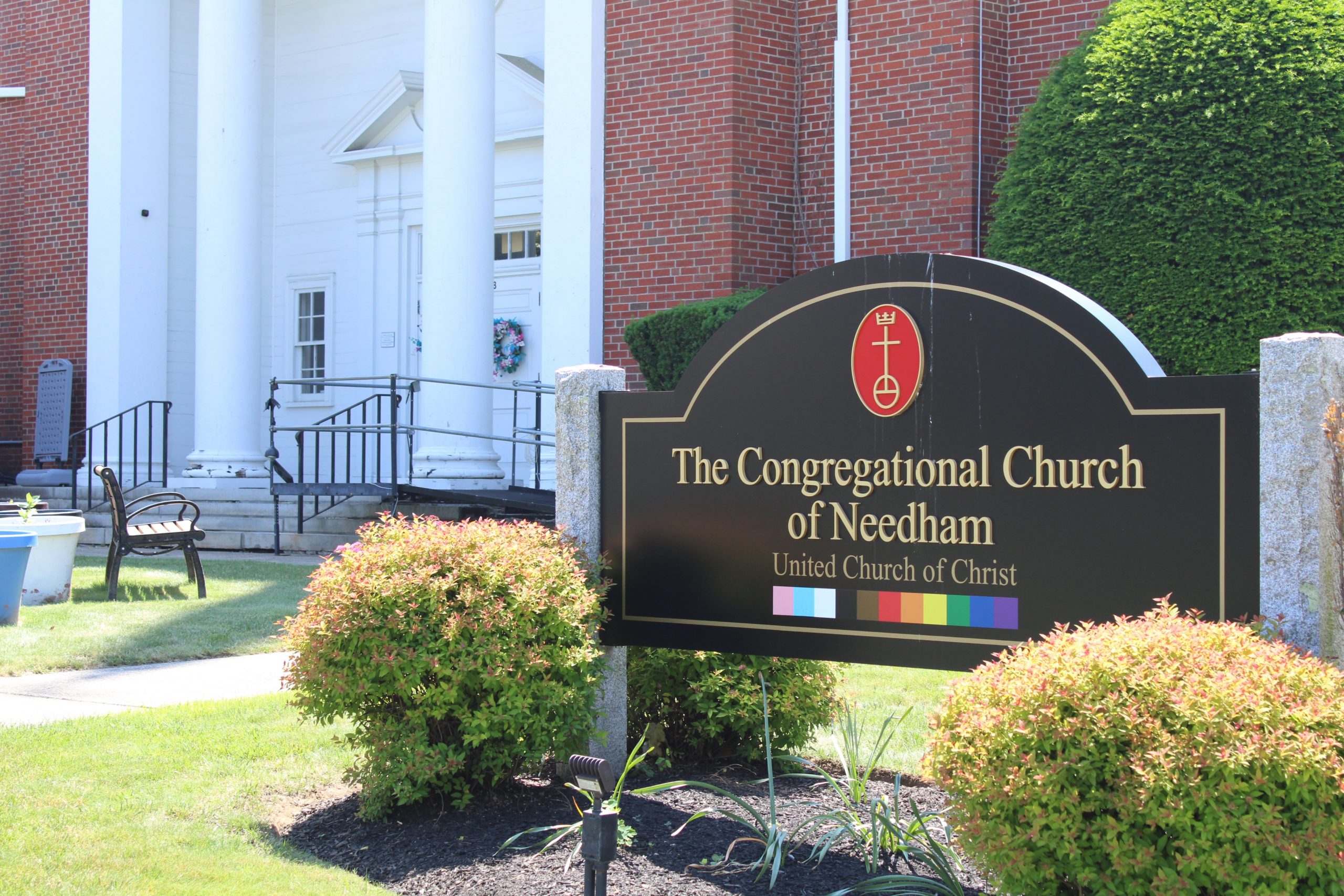
Twenty-five years ago, the Congregational Church in Needham made its “open and affirming” pledge, joining a handful of other congregations in committing to welcome LGBTQ parishioners.
Much has changed since then, and Rev. John Gage said the church has played catch-up to include more gender identities and expressions, particularly transgender and non-binary people. His church displays rainbow-colored planters outside, as well as Pride-themed signs and flags.
Needham’s First Parish is a “welcoming congregation,” which includes a similar mission to practice inclusion for the LGBTQ community. Rev. Catie Scudera said about 25% of her congregation identifies as LGBTQ.
As spiritual leaders, Gage and Scudera recognize that those acts of solidarity, however big or small, are perhaps unconventional within traditional places of worship.
“A lot of folks grew up in congregations that were not open and affirming, that were not welcoming,” Scudera said, “and many people drifted from organized religion entirely for years, decades of their lives.”
During Pride Month, leaders of local religious institutions addressed their role in honoring queer people and how doing so is inextricably tied to their faith.
Within progressive Judaism, “it’s very easy to embrace all people,” Rabbi Jay Perlman of Temple Beth Shalom said. He cited the Book of Genesis, in which God creates humanity in his likeness, known as Tzelem Elokim in Hebrew. Each person, in that sense, “has a spark of the holy within them,” Perlman said, meaning one is called to affirm all people and expressions.
“It’s like breathing,” he said. “We don’t get any credit for honoring all people. This is just part of the way that we walk in this world, by holding each other.”
The Congregational Church of Needham, part of the United Church of Christ, follows a similar philosophy. Because God created people in his image, he “loves each of us as we are,” their website reads.
Embracing someone’s identity keeps them safe, Gage said, and it “provides an anchor” in their lives. “That’s at the core of our work,” he said.
For people who are or aren’t religious, Christian churches that openly welcome LGBTQ parishioners are sacred, Gage said.
“So many people checked out of religion early on because it was not affirming for them,” Gage said, “and even if they never come to one of our services, [there are] people who just tell me that are so excited, they’re glad that a place like this exists.”
The UCC and First Parish held a Pride Month concert with musician Bobby Jo Valentine in early June. The two congregations have recently held small-scale Pride parades between the two churches, just blocks from each other in Needham Center, in a celebration they’ve dubbed Needham Has Pride.
Since their first Pride party in 2021, the events have garnered about 100 people, Gage said. The celebrations bring the community together in a special way, Scudera said.
“I want my kid to see that this is a welcoming community and that, ‘Oh, there’s our neighbor who’s also here, either as an ally or as a queer person. Maybe we didn’t know, but now we all know,’” she said. “Everybody’s out.”
Temple Beth Shalom held a Pride Shabbat, during which they read poetry and prose to elevate the LGBTQ community that is “tightly woven” in the broader synagogue community, Rabbi Perlman said. In conversations with LGBTQ people, Perlman said many feel vulnerable and under attack.
“When someone is in need, we embrace them, we hold them, we strengthen them, we let them know that they are seen and heard,” he said, “and hopefully that they will find strength through the shared relationship that we hold and that we honor.”
Incidents of hate crimes based on gender identity and sexual orientation are on the rise, according to data from the FBI. Crimes against sexual orientation made up almost 19% of all reported crimes, behind race and religion, in 2023. Legislative action labeled as anti-LGBTQ, as well as new federal gender policies, have perhaps shifted the tone of Pride Month.
Those governmental policies coincide with change in United Methodist churches, which voted decisively last year to allow LGBTQ people to be ordained. The change, debated within the religion for decades, caused a sizable percentage of churches to disaffiliate.
Carter Memorial in Needham, however, has stayed. Rev. Sandra Bonnette-Kim said it reflects the church’s updated mission: “Carter Memorial UMC is a multi-generational spirit-led Christian community where all are accepted and nurtured.”
UMC congregations can commit to becoming a “reconciling congregation,” acknowledging that they welcome diverse parishioners, but Needham decided not to, given that governing rules around Methodist churches have relaxed in recent years.
“Because this congregation has always been open, and we have trans people and trans youth in our church, that never had been an issue in this church,” said Bonnette-Kim, who co-chairs Needham Interfaith Clergy Association. “I think that’s one of the reasons I’m not hearing as much and feel the need as much, because they have always been very open and accepting, at least with the LGBTQ issue.”
At First Parish, Scudera and others are focusing on non-spiritual advocacy and support, including name-change clinics, where transgender and gender queer people receive help filing paperwork to legally change their name on government documents. The Massachusetts Transgender Political Coalition hosted those clinics.
Finn Gardiner, advocacy and organizing manager at the MTPC, spoke about the importance in providing space, particularly for trans people. The MTPC’s newly formed interfaith network is “working to ensure that trans people have a place to worship” and are able to “connect with a higher power,” Gardiner said.
“I think that being in an affirming religious environment helps people become who they are,” Gardiner said. “It helps their mental health. Being spiritually connected has a lot of mental health benefits.”
About 42% of LGBTQ people in Massachusetts are religious, according to a 2020 report by the Williams Institute at the UCLA School of Law.
Pride Month encompasses just 30 days, but for Perlman, those values must extend beyond June. At TBS, that means honoring parishioners for 365 days each year.
“For us, the LGBTQ+ community is an integral part of the broader Temple Beth Shalom community and our collective societal community, and so that’s just super important,” Perlman said. “So, it cannot only be a month. It needs to be a way of walking in this world and living in this world.”
Pride is an expression of joy, which Gage said comes, this year, at a pivotal time.
“It is political in that joy is political, when people are trying to keep you down and demean you and degrade you and write you off, then claiming your joy is political,” Gage said, “but it’s also just beautiful and lovely, and that’s what I’ve experienced.”