Sharing the Art of the Craft

December 15, 2025
• During a holiday open studios event, artists displayed their work and mused about their passion and techniques.
Potters sat at their wheels, threw down clay and shaped their creations firing up the kiln. Upstairs, a weaver worked on a rug, while others inspected their canvases and shared their materials and finished products.
Within the three-story Gorse Mill Studios — the last mill still standing in Needham — more than 30 artists create in a range of mediums. Painters, mosaic artists, sculptors and other creatives opened their studio doors for a holiday market and showcase on Sunday.
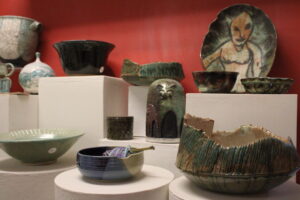
The Potters Shop, on the ground floor, bustled with students, staff and visitors. Bowls, cups, plates, vases and more filled the shelves. Needham artist Barbara Levitov started building up her clay in the hopes of making a pie dish, while Newton South High School junior Judah Kaunfer added details along the sides of a vase.
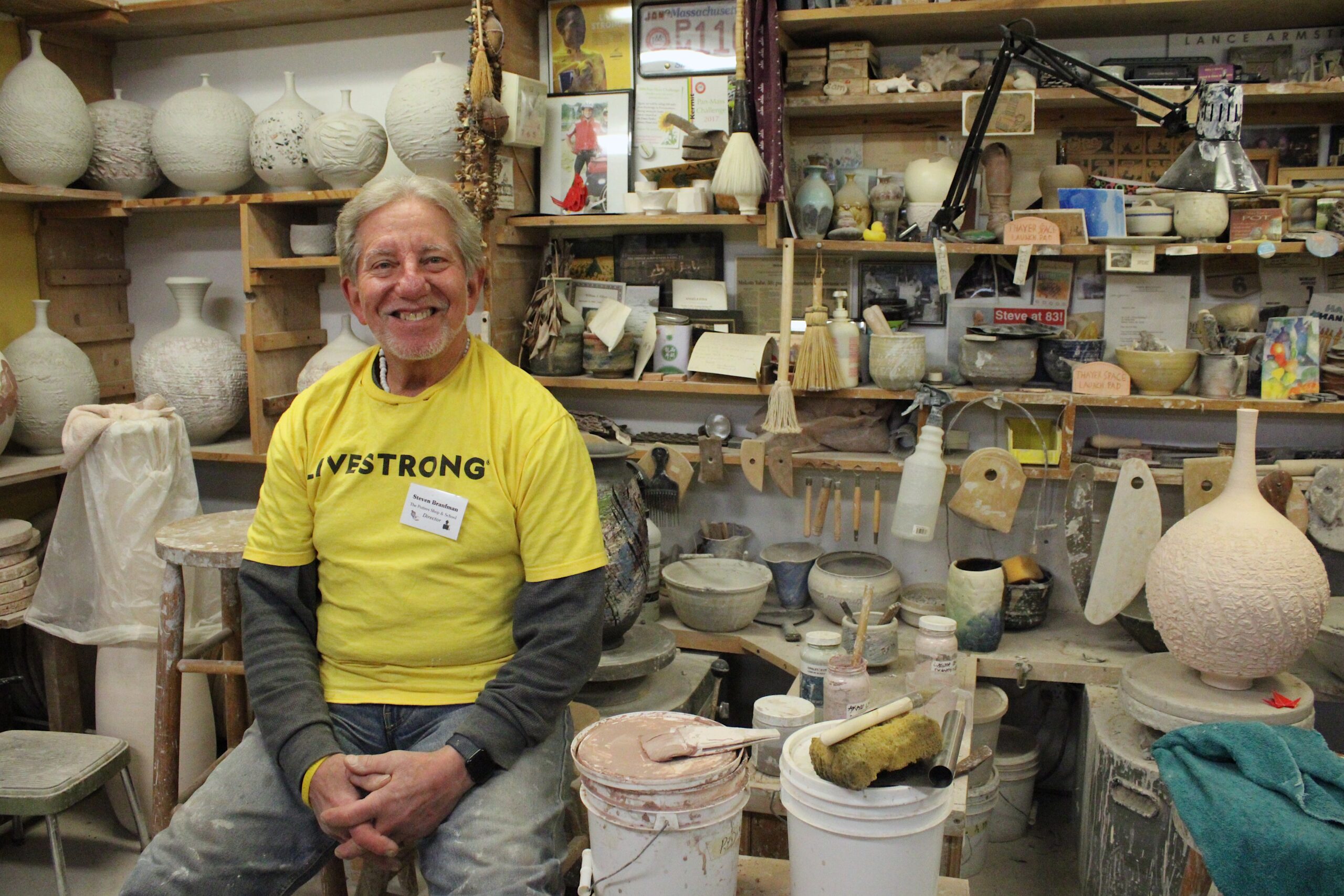
Steven Branfman, who bought the mill and founded the Potters Shop, stood within his own studio down the hall, where his large collection of Raku pottery sat along the perimeter of the space. Raku is a Japanese-style pottery wherein pots are fired quickly in a small kiln and glazed while still molten.
Branfman, like other artists who spoke with Needham Local, fell in love with his chosen art form immediately. A high school sculpture class “changed my life,” he said, and his first college studio class in clay converted Branfman the jock into Branfman the artist.
“I had never done anything with clay before, and as soon as I touched it, I knew that this is what I wanted to do,” he said in his studio.
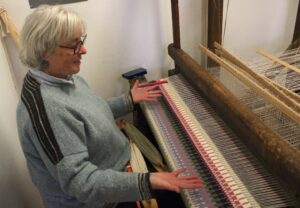
Christine Frieze sat behind her 18th century barn loom, with 26 inches of a woven rug in front of her. She still had 22 inches to go, and each inch takes her about an hour. The piece will be a wedding gift for her niece, the daughter of her sister Maura Glandorf with whom she shares her studio.
They call themselves “the weaver and the painter.”
The loom fills up nearly a third of the room, while Glandorf’s easel and painting supplies are arranged by the window. The sisters carry on a family tradition of craftsmanship, with carpenters, musicians and hand-craftsmen in their lineage.
After picking up a loom from an estate sale — she is intrigued by “the mechanics of things,” which drew her to pick up the device — Frieze said she had trouble finding a teacher. She ended up traveling to a school in Marshfield, Vermont to pick up the craft about eight years ago.
“She had about a dozen of these looms in there, and it was just vibrating… When I walked into this barn and I heard this,” Frieze said as she maneuvered her loom, creating a loud thud, “but a dozen of them, I was like, ‘what have I stumbled upon?’ And I was hooked after that.”
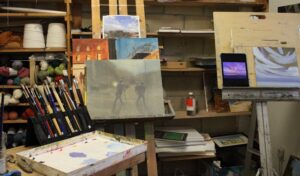
Frieze and Glandorf received a serendipitous call about open studio space in early 2020, and the room became an artistic sanctuary during the pandemic. They shared a bedroom growing up, so they figured they could coexist just fine.
They both welcomed guests into the space Sunday, showing their work and explaining their processes.
For Glandorf, who returned to painting in retirement after a career as an accountant, she’s fully embraced her creative side. Leaning on her easel was a photo of a colorful sky, which she’s using as inspiration for her next piece. Much of her work is landscapes, but a couple portraits hung by the front door.
“I always wanted to paint, and I said, ‘I’ll just do it as a side hobby.’ But then life got in the way, and I had kids and work and whatever,” Glandorf said. “When I retired, I came back to painting. It’s been a joy to be able to do it.”
Customers milled about, picking up gifts for loved ones before the holidays. In Nicole Donson’s studio, a couple picked up a silk scarf for a friend in Florida.
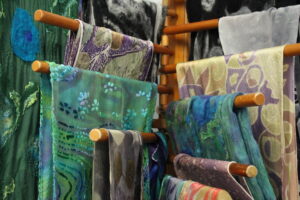
Donson does silk painting, a technique in which silk is stretched tightly and painted, creating ombré effects — color blending — as well as more detailed artwork.
“When you work with the silk, it doesn’t glide, it just spreads,” Donson said. “I can’t really explain what it does. It’s like magic.”
Donson creates scarves, skirts, kimono jackets and other silk pieces. She’s worked in the medium for 25 years and teaches the craft within her studio.
At the Potters Shop, Branfman estimates they teach more than 100 students, and the works of several dozen were on display and for sale on Sunday. The building “has a long history of handmade things,” dating back to its origins as a textile mill in the late 1800s, and he seemed pleased to see the space, now in its 16th year, live on.
“It’s a very, very happy place,” he said.