Needham History: Didn’t He KNOW When He Died?

Capt. John Fisher got caught in a time warp, of sorts.
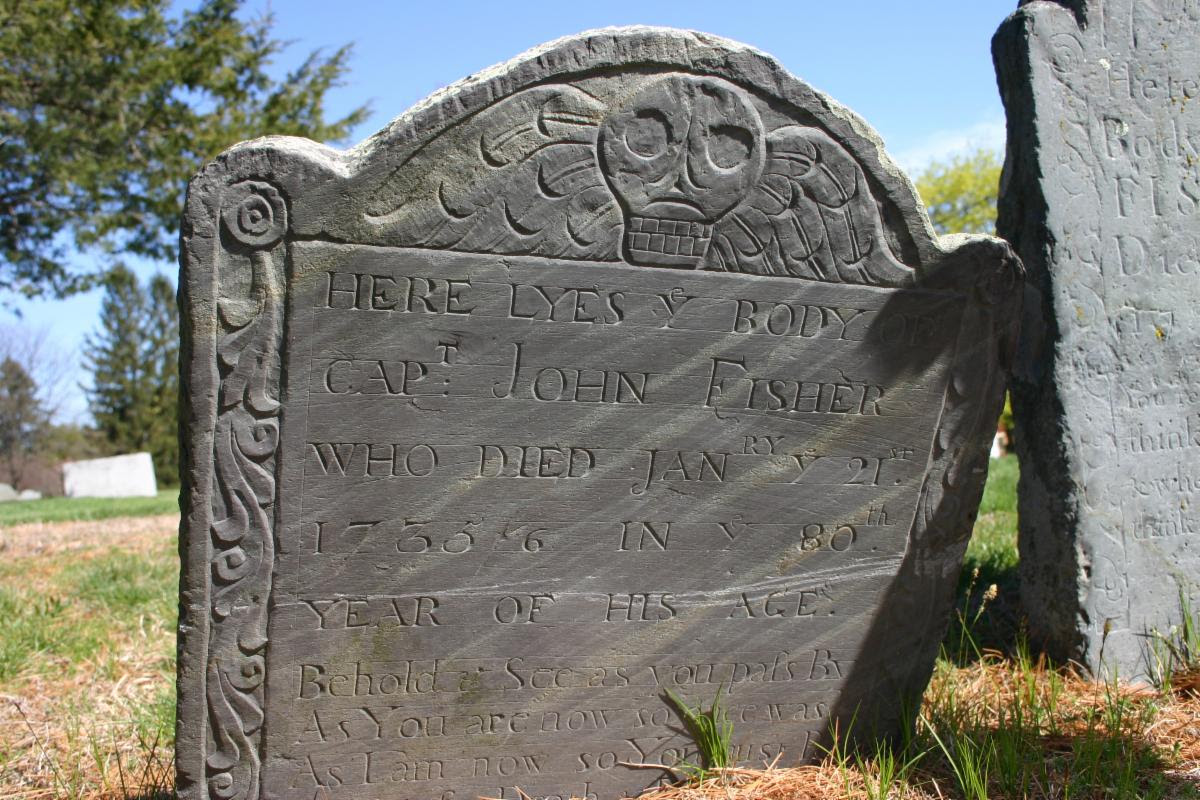 The gravestone n the Needham Cemetery for Capt. John Fisher, who died in 1735. Or maybe 1736.
Didn’t He KNOW When He Died?
Captain John Fisher passed away in Needham at the very ripe old age of 79. He was born in 1656, when Needham was still the North Parish of Dedham. His grandfather and other family members owned land in the area of what is now Central Avenue at Fisher Street since at least 1650. In his long life, Capt. John served the towns of Dedham and then Needham in a number of elected offices. He received his rank during King Philip’s War (1675-78) as Captain of the first militia company in the North Parish. In 1703, MA Governor Dudley appointed him responsible for the Praying Indian community at Natick. John Fisher led the building committee that built the first Meeting House in 1713. He was one of Needham’s first Selectmen, elected in 1711 and serving in the office for seven years between 1711 and 1726, alternating with the office of Town Clerk (four years).
He passed away, much respected and lamented, and was buried in the Needham Cemetery in 1735. Or maybe 1736.
Wait – how could they not know?
Here Lyes ye Body of
Capt. John Fisher
Who died Janry ye 21st
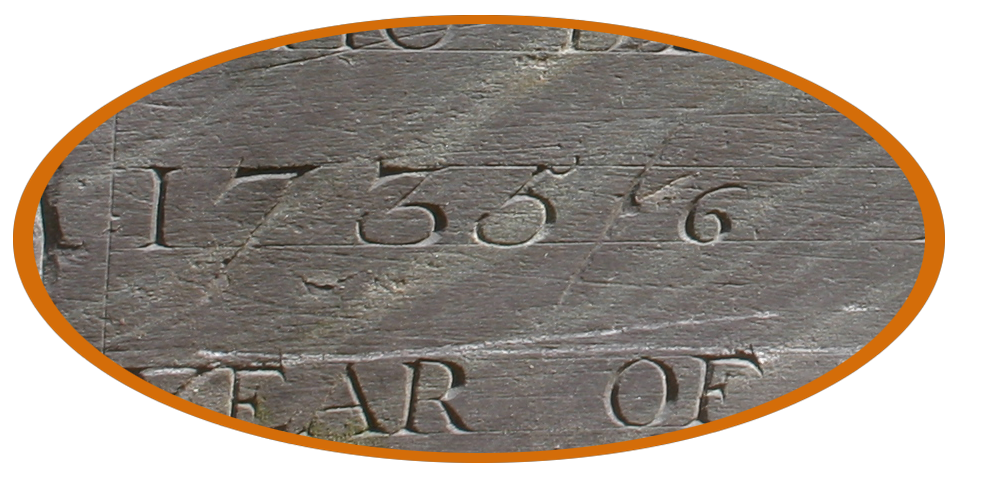
1735/6 in ye 80th
Year of his Age.Behold & See as You pafs By,
As You are now so once was I.
As I am now so You must be.
Prepare for Death and follow me.
Right there on his gravestone – 1735… or 1736. What’s going on?
What’s going on was a long-standing dispute about the Calendar, a dispute that dates all the way back to the Roman Empire.
In 46 BCE, Julius Caesar declared a new calendar (named after himself, of course) of twelve 365-day months, with an extra day every four years to account for differences between the solar and lunar cycles. Prior to this, the Roman calendar consisted of 12 months and 355 days, with 22-27 extra days (“intercalcary” days) inserted in February to make the calendar year align with the solar year. Also, calendar calculations throughout the Empire were varied. The Julian Calendar was intended to regularize the dating system across Rome’s widespread empire, eliminate the intercalcary days, and begin the year on a consistent January 1 date. All fine – sounds pretty familiar so far.
Detail showing Capt. John Fisher’s ‘dual date’ – 1735/6
The problems began after the fall of the Roman Empire and the widespread adoption of Christianity in Europe. Gradually, the date of the new year began to shift from January 1 to March 25, the Feast of the Annunciation (celebrating the day when the Archangel Gabriel appeared to the Virgin Mary, informing her that she would give birth to Jesus). Also, as time passed, it became clear that the Julian year was just slightly longer than the solar year, and that the year gained an extra day every 400 years.
… for such a beastly month as February,
twenty-eight days as a rule are plenty …Gilbert & Sullivan, The Pirates of Penzance
So in 1582, Pope Greogry XIII declared a new calendar, based on the Julian calendar but with modifications to stop the forward drift. The new year was restored to January 1, and the year had 12 months of 30 or 31 days, with one shorter month (February) and a leap day every four years. This was an important consideration for the Catholic church, because the forward drift of the Julian calendar had caused the date of March 21, the traditional date of the spring equinox, to occur after the actual solar equinox, confusing the calculations for the date of Easter.
Catholic countries in Europe adopted the Gregorian calendar right away, necessitating an 11-day shift in the date to recalibrate. In Spain, Portugal, Italy, Poland, and the Papal States, 4 October 1582 was followed the next day by 15 October. Catholic countries in western Europe adopted the calendar a couple of months later (9 December was followed by 20 December).
Protestant Europe, however, was not on board. In England, the calendar change was seen as just one more sinister way that the Catholic Church was trying to re-convert the country (the bloody sectarian years of Queen Mary’s reign were still within living memory). As a result, England and its possessions did not adopt the Gregorian calendar until 1752, another 170 years. For this reason, official English documents before 1752 that cite months have to be reckoned from March – for example, a land deed in our collections dated “ye 15th of ye 6th Month 1636” dates to August 15th, and not June 15th.
So how did this affect poor old Capt. John? Because of the gap in adoption, the years between Needham’s founding in 1711 and the official adoption of the Gregorian Calendar by England in 1752 were governed by two dating systems – the Old Style (Julian Calendar, often noted in dates as “O.S.”) and the New Style (Gregorian Calendar, “N.S.”). Dates that fell between January 1 and March 25 fell into both years – the new year by the Gregorian calendar, and the old year by the Julian calendar.
There are at least 26 Needham deaths with dual dates, as recorded in the parish and town records. Oddly, the only extant gravestone for this group is that of Capt. John Fisher. I don’t really know the reason that so many of the others are missing. Needham had only one cemetery during this time – all burials had to be in the Cemetery, and there are none of the small private cemeteries in Needham like there are in other New England towns (the other cemeteries – West Needham/Wellesley, St Mary’s, Woodlawn, were established later). The stones should be here, unless they were never made or they went missing over the years.
So, Capt. John died on January 21, 1736 (N.S.), though in the old reckoning, it was January 21, 1735 (O.S.). So his gravestone included both. It may seem odd to us, and weirdly ambiguous. But for Capt. John? He was just doubly certain.
 |
Gloria Polizzotti Greis is the Executive Director of the Needham History Center & Museum. For more information, please see their website at www.needhamhistory.org. |