Residents Remember Loved Ones at Day of the Dead Celebration

November 10, 2025
• Members of Needham’s Hispanic community hosted the cultural holiday at an event at the Needham Free Public Library on Saturday.
Growing up in northern Mexico, in Chihuahua, Massiel Gallardo didn’t celebrate Día de Muertos, known as Day of the Dead. The holiday, which some believe dates back to the Aztecs, is more widely observed in central and southern Mexico, Gallardo said.
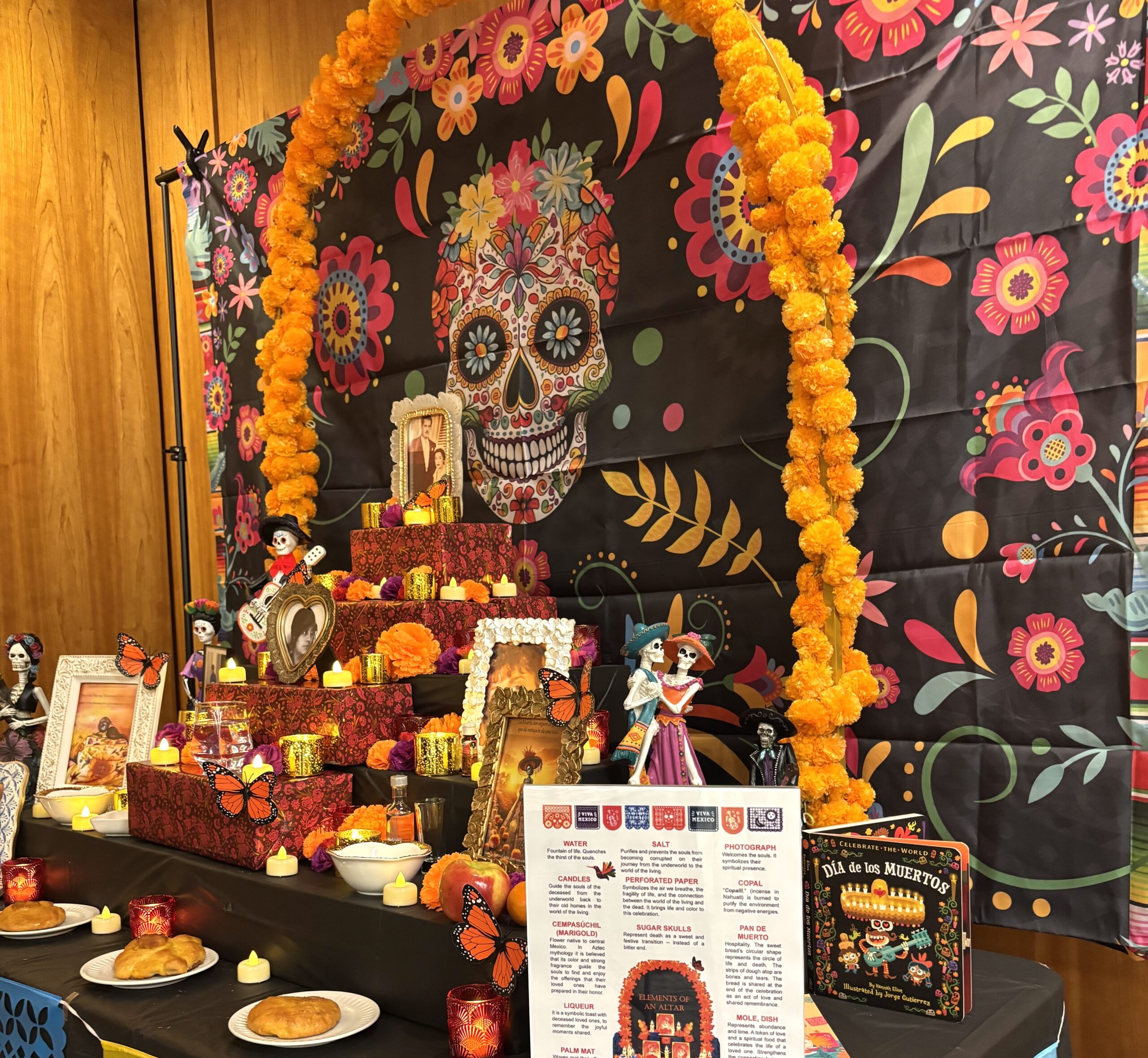
But on Saturday morning, Gallardo set up her first Day of the Dead altar, a key piece of the holiday that honors loved ones who have passed on. She brought photos of her grandparents and two aunts who have passed away, along with candles and items that reminded her of them.
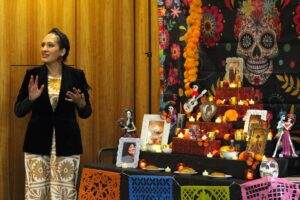
Gallardo, with co-organizer Ana Ly, shared the Mexican holiday at the Needham Free Public Library with the broader community. It’s an event she’s hoped to host for more than five years, she said.
“I just want for our voices and our culture, and our heritage to carry on and be proud of it,” Gallardo said. “This is just a big celebration for me to go back to my roots, to celebrate my heritage, but also for my children to get to see it and to have community participation in something that is so close to their mom’s side of the family and the traditions of Mexico.”
In the library’s community room, families colored skull masks and learned about the symbolic ties between the holiday and the migration of Monarch butterflies — the butterflies travel from Canada down to Mexico by early November, becoming synonymous with the tradition.
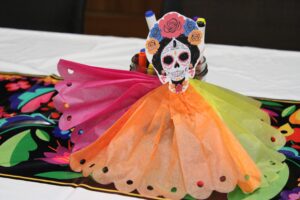
Axel Gonzalez and his six-year-old son Emilio designed their own skulls, which are featured prominently during Day of the Dead festivities. Gonzalez, who is originally from Mexico, celebrated the holiday as a child and fondly recalled trips to night markets where he bought toys and sugar skulls.
Day of the Dead turns grief into a party, Gonzalez said. Since having children, he said he hopes to reengage with the holiday to share it with his family.
“That’s the reason why we are here, because I want my kids to start getting more familiar with that tradition,” he said. “It’s when you celebrate your loved ones that have gone, passed. And it’s more of a celebration than anything else.” Over the holiday, he said he was thinking about his grandparents.
On the altar, former Library Trustee Anna Giraldo-Kerr placed a photo of Rick Hardy, another trustee who passed away in 2022. She considered Hardy a friend and mentor.
“It’s more of a legacy. It’s your people, your grandmother, great-grandmother, all of your lineage and those who have played a significant role in our lives,” Giraldo-Kerr said of the altar. “We tend to forget they’re with us. The Día de Muertos celebration helps us reconnect with their spirit.”
During Día de Muertos, living souls reunite with their dead family and friends, and the altar presents offerings for those loved ones who passed on. It’s typically observed Nov. 1 and 2.
Altars are decorated with candles, perforated paper and marigolds, a flower native to central Mexico whose scent is believed to guide traveling souls to the altar for the holiday. Water and pan de muerto, a Mexican sweet bread, are also placed around the altar as a showcase of hospitality.
“In Aztec mythology, they perceive it as you have the souls coming from the underground, from the afterlife, and they have to transverse about seven underworlds,” Gallardo explained to attendees Saturday, “and so they believe, you get here, ‘thank you for being here, for making it, you must be thirsty.’”
Max Feldman’s 2-year-old son Camilo was enthralled by videos of the Monarch butterflies and the colorful altar. The elder Feldman said the talk on Saturday made him more curious about the holiday, which he’d only learned about through popular culture.
“An event like this, for me, seemed like an interesting way to open the door to learning about something in a deeper way,” he said.
For Gallardo, she thinks about her maternal grandmother this time of year. “She’s still, to this day, this guiding force,” she said, “a blanket of love that carries on through time.”
“That’s the whole meaning behind this celebration, a celebration of life, and to honor our loved ones, and just to keep the memory alive,” Gallardo added. “[At the altar], they recommend you light a candle, tell a story and let the memories warm your heart. That’s the essence of Día de Muertos.”