Needham History: Who Doesn’t Love a Wall?

A problem, but also a solution
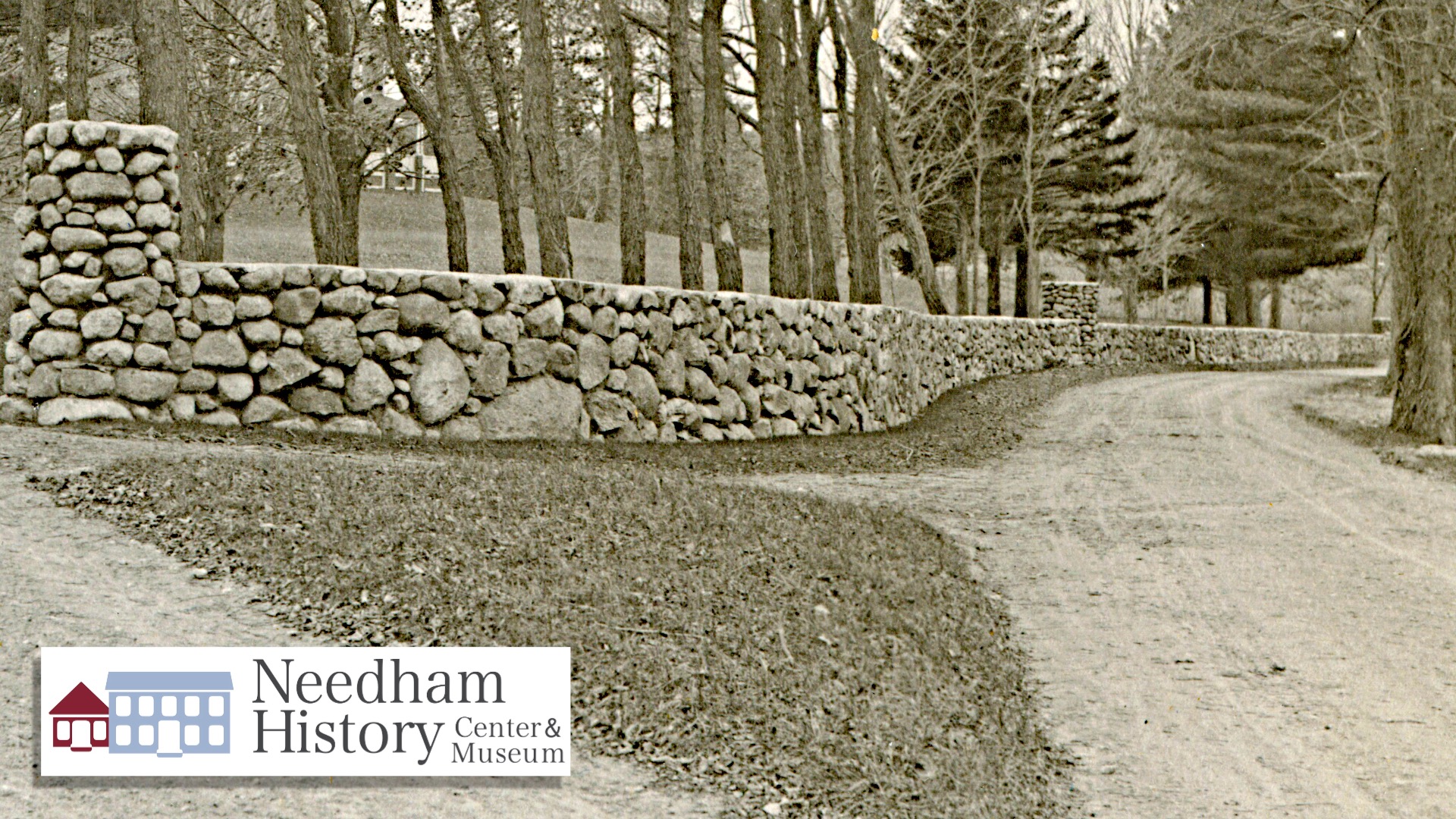
 The old center at Central Avenue and Nehoiden Street, circa 1870 (looking northeast from what is now Dwight Rd.). The stone wall separates the houseyard of 963 Central Avenue (still standing) from the plowed field in the foreground. This wall is now mostly gone.
Who Doesn’t Love a Wall?
The stone wall, though, has twice outlived its builder:
He who plucked the granite from heavy, stubborn soil.
Dragging, rolling, hefting the puzzle pieces into place…
I have been walking a lot lately, usually with my friend Kim Marie Nicols around the lovely Amity Path that encircles the Dedham Avenue Reservoir. This week, for a change of scenery, we decided to head out to Marlboro to take a walk around Lake Williams – a route that is half rugged woodland path, and half floating boardwalk (and entirely worth the effort – check it out!) The path in the woods is narrow, crossed by rocks, tree roots and many old fieldstone walls. The walls barely allow passage, even in single file – a stone or two moved aside, a grudging accommodation to the necessities of public access.
This got us talking about the stone walls. Anyone who is new to New England (either from somewhere else, or a child newly aware of their surroundings) always has the same question – why are there random stone walls in the woods? The short answer, of course, is that they did have a purpose, and they weren’t always in the woods.
The absolute authority on New England stone walls is Robert Thorson, professor of Earth Sciences at University of Connecticut. Dr Thorson has studied and written about New England’s stone walls, both as a personal interest, and in the context of how people interact with the geology of the land they live on. Using data from satellite and lidar (pulsing laser) imagery he has also assembled some astonishing facts, to wit:
• There are currently an estimated 100,000 miles of fieldstone walls remaining in New England, long enough to circle the earth four times
• There were originally an estimated total of 240,000 miles of stone walls…
• …representing about 400 million tons of rock, enough to build the Great Pyramid sixty times over
Most of the stone walls in New England were built in the 1700s and 1800s, but they date as far back as the 1600s. The oldest known wall is in Popham, Maine, and dates to 1607. Our soils are notoriously rocky, a leftover from the glaciers that covered the land until 10,000 years ago. So any clearance for agricultural use necessitated the removal of these rocks. Certainly you could not plow through them; but the grazing land also had to be cleared. In the 17th century, when European farmers first arrived here, most of New England was thickly forested. By 1800, nearly all of it was deforested as the trees were cleared for building, fuel, and to make way for the needs of European patterns of agriculture.
The rocks, then, were both a problem and a solution. As they were dug out of the soil, they needed to be put somewhere. And as crops and livestock took over the land, they needed to be managed and constrained. As more and more settlers arrived, boundaries needed to be marked. So all those rocks were turned into walls – walls that separated the crops from the pasture, walls that kept the livestock from wandering into the fields, walls that marked the boundaries between your land and your neighbor’s, and walls that delineated the roads and paths. Bit by bit, the walls created a map of the land use, residential geography, and social organization of colonial New England.
Top: Stone walls around the Robert Fuller house (built 1707) on Forest Street; parts of these walls are still standing, and probably date to the mid-1700s.
Bottom: Fences and stone walls keep cattle in their pasture on South Street, circa 1900.
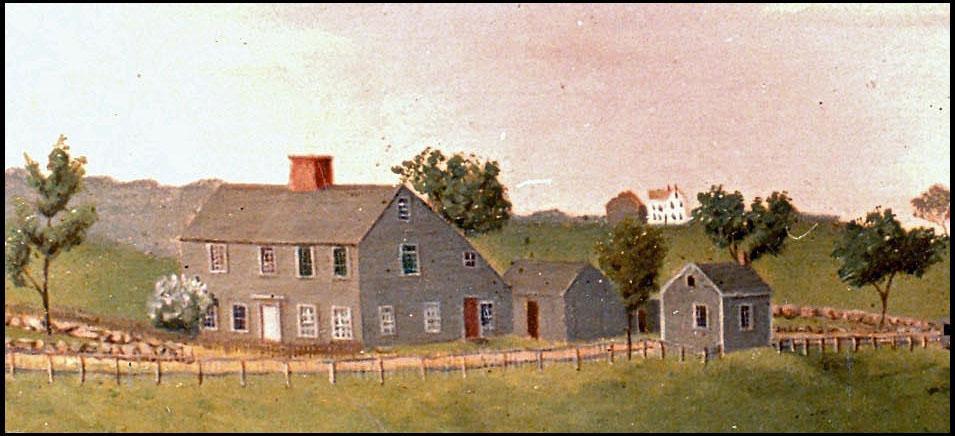
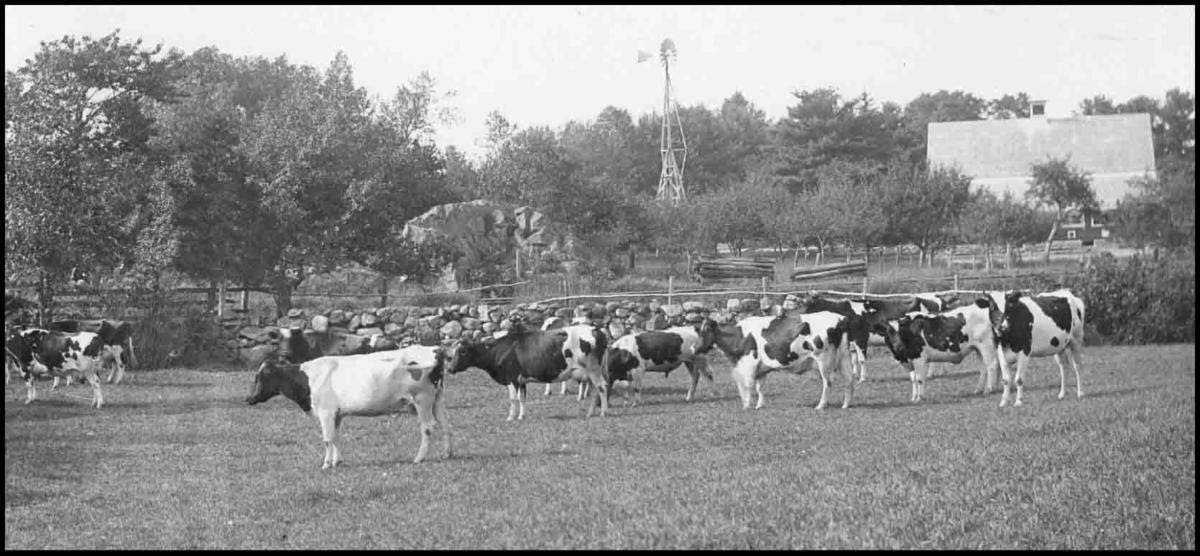
The building method was pretty simple – rocks piled onto each other along a line that marked a boundary. These are unshaped fieldstones, though choosing a compatible shape from among the available rocks was an art that minimized slumping and contributed to the durability of the wall. Some of the rocks were large and heavy enough to require several people to lift and place, but most were the so-called “two-handers” – light enough for a farmer to lift by himself, but heavy enough that he needed both hands to do it. Typical wall height was about three feet, which was about waist-high, enough to deter cattle and about as high as a rock could be comfortably lifted.
But as hard as they are to build, fieldstone walls are surprisingly easy to tumble down. Frost heaves unbalance the rocks little by little. Small critters burrow into them to make nests, and larger critters dig in to hunt them. As farming was abandoned in the 19th and 20th centuries, the fields reverted to woods; trees and branches fell on the walls, and saplings grew up through them.
Most famous fieldstone wall in America is arguably the wall on the farm in Derry, NH that was owned by Robert Frost, and about which he wrote “Mending Wall,” his famous poem about a neighbor’s insistence on annual wall-maintenance:
Something there is that doesn’t love a wall,
That sends the frozen-ground-swell under it,
And spills the upper boulders in the sun……There where it is we do not need the wall:
He is all pine and I am apple orchard.
My apple trees will never get across
And eat the cones under his pines, I tell him.
He only says, ‘Good fences make good neighbors.’
Needham, of course, was a farming town so it has its share of fieldstone walls. Old photos show the walls running through our landscape. We did not have a lot of plow land because our water table is so high and our soil is acidic, but we had great grazing land. Cattle raising was the mainstay of the Needham farming economy, and Needham had several dairies that operated in town until the 1950s. As the land got subdivided into house lots, a lot of the walls were removed. But when they were on a property boundary or along a road, or when the land reverted to woodland (as on North Hill at East Militia Heights Road), the walls remain to remind us of our farming past.
I’ll let Robert Thorson sum it all up:
“Importantly, each of these binding threads tells nearly the same human story. Of the absence of marked boundaries on Indigenous land prior to their dispossession. Of the courage of pioneering settlers, the backbreaking work of families, the creation of sunny open spaces and the pride of farm ownership. Of the 19th-century economic decline, the devaluation of agrarian life and the wholescale abandonment of rural land. Of the 20th-century healing organic redemption of woodland ecology… And of the renewed 21st-century interest in historic stone walls to help anchor us in the storm of modernity.” (Smithsonian Magazine, November 2023).
So, the walls are tangible things – boundaries, corrals, pathways. But the walls are also metaphors. They represent the stony determination of our forebears to tame the wild land they settled on, as they struggled to make a living and to recreate their old homes in this new place.
…In time, the passing years gathered up the man
and crusted stone with olive moss and lichen gray.
Stumbling with age and witness to a different time,
still, there are stories harbored here,
meaning to be found in the wall’s enduring presence,
if only that, when I am gone, the silent stones will stay.
**Sources: First and last poetry quotes are from “The Old Stone Wall” by Laurie A. Chandler, 2017. The second poetry quote is from “Mending Wall,” by Robert Frost, 1916. Other sources include: Exploring New England’s Stone Walls with Robert Thorson, northernwoodlands.org/blog/article/stone-walls-robert-thorson; New England Is Crisscrossed with Thousands of Miles of Stone Walls,
atlasobscura.com/articles/new-england-stone-walls; How Stone Walls Became a Signature Landform of New England, smithsonianmag.com/travel/how-stone-walls-became-a-signature-landform-of-new-england-180983250/; and The Surprising Story Behind New England’s Stone Walls, outdoors.org/resources/amc-outdoors/history/history-of-new-englands-stone-walls/
 |
Gloria Polizzotti Greis is the Executive Director of the Needham History Center & Museum. For more information, please see their website at www.needhamhistory.org. |