Needham History: The Revere-Adjacent Blake & Sons Bell

Not *quite* Revere, but oh-so-close!
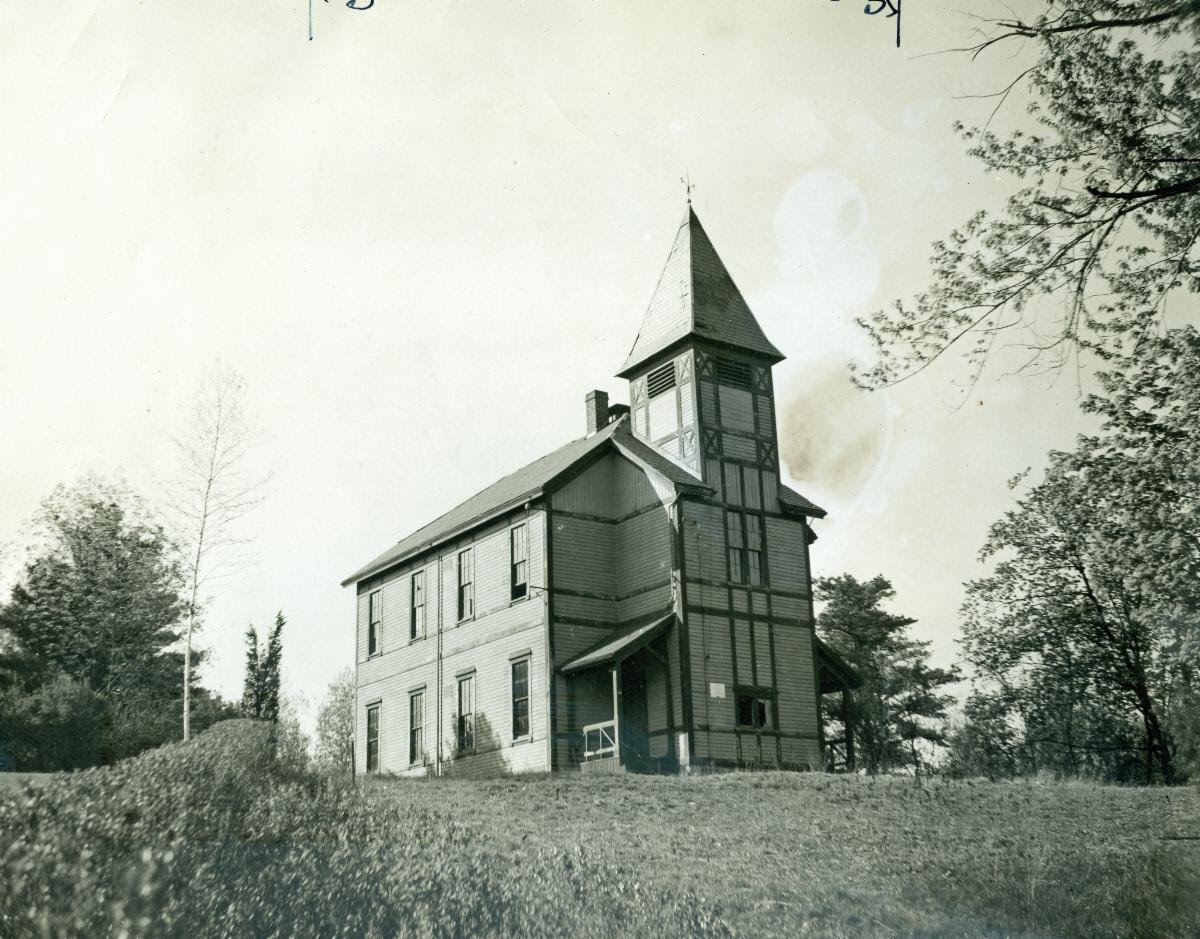 The Parker School on Charles River Street. The bell was purchased for the tower, and served as both a school bell and an alarm bell.
The Blake Bell
I live in the Heights, so I drive past Fire Station #2 nearly every day. This is our third Heights fire station, replacing the firehouse that was built in 1948 on the same corner, which replaced the old 1885 station that was located farther up Highland Avenue on the site that is now the CVS.
Fire stations usually have towers. In the past, the tower was functional, and held the alarm bell, as well as serving as an observation point and as a place to hang the long canvas hoses to dry. These days the tower, when present, is more of an iconic embellishment than a functional structure; but it links the firehouses to their histories.
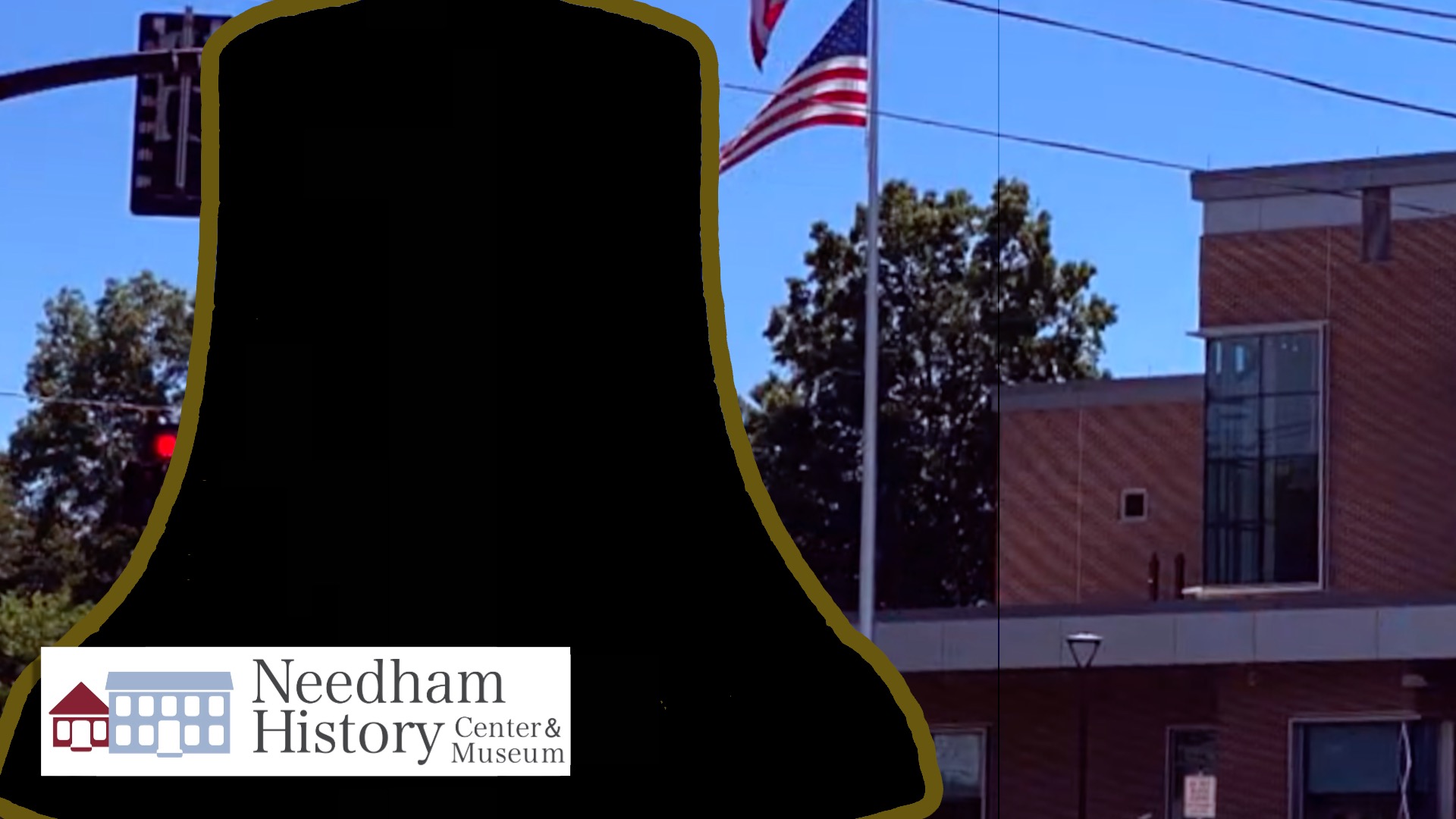
The Heights station has a tower – a decorative, glass-walled structure. And it also showcases some history – the Blake Bell.
The Blake Bell is the bell that used to rest on the lawn in front of the History Center’s former home on Glendoon Road. We took it with us when we moved to the Mills House and set it up in front of the Schoolhouse. A few years ago, at the request of former Chief Dennis Condon, we agreed to loan it to the Fire Department for display in the new Heights Station.
The bell was originally installed in the tower of the Parker School, on Charles River Street. Parker was a small school with a large bell tower, making it look a little like a church. It was built in 1876 to serve the remote Charles River Village area of town. This area needed its own school, because it was too far from the center of town for the other schools to be convenient. The reason both the bell and tower were so large (relative to regular schools/bells) was that the bell served not only as the school bell, but as the emergency/fire bell for that part of town because the bells at the other fire stations could not be heard at that distance. The Parker School was closed around 1938, and demolished a few years later.
After the Parker was demolished in 1941, the bell was moved to the old Heights fire station (Station #2), which at the time was near the corner of Highland Avenue and Mellen Street. When the old station was replaced in 1949 with a new station at the corner of Highland Avenue and Webster Street, the bell was given to the Needham Historical Society.
The Historical Society (now the Needham History Center & Museum) bought the Kingsbury-Whitaker House at 53 Glendoon Road in 1949 for its first headquarters. The recently-given bell was placed on the front lawn and it was a familiar and iconic sight for many years. We brought it to our current location in front of the Newman Elementary School when we moved here in 2006. We placed it in front of the Schoolhouse. Unfortunately, the topography of the site, which slopes down from Central Avenue, made the bell difficult to see.
I have frequently been asked if the bell is a Revere Bell, like the one in the First Parish steeple. It’s not, but it is a Blake, which is – literally – the next-best thing. William Blake was an apprentice of Paul Revere’s grandson, Paul III, and worked at the Revere Bell foundry. In 1823, Blake went into partnership with Paul III to form the Blake & Revere Foundry, later adding apprentice Henry N. Hooper to become Blake, Revere & Hooper. Blake and Hooper later partnered with Thomas Richardson to form the Hooper, Blake & Richardson Company, later known as Hooper & Company. It appears that Blake also had an office on Allen Street in Boston from about 1820 to 1890, operating variously as William Blake & Company, William Blake & Son, or the Blake Bell Company. When William Blake died in 1871, his son William S. Blake took over the business. William S. died in 1893, though the company carried on to about 1900 before it closed, or maybe moved to Waterbury, Connecticut.
In its day, Blake’s companies were busy and innovative bell-makers, and they made hundreds of church and school bells. Many are still in use in this area. In 1825, Blake cast the first sets of chimes made by an American foundry – one set of eight bells, and one of eleven bells. Until this time, chimes (each bell tuned to a particular note) were cast in Europe and had to be imported. Metal-casting – and especially the bells, cannon, and sheet-metal work that Paul Revere pioneered and his descendants and apprentices like Blake continued – were important industries for establishing the industrial independence of our young country.*
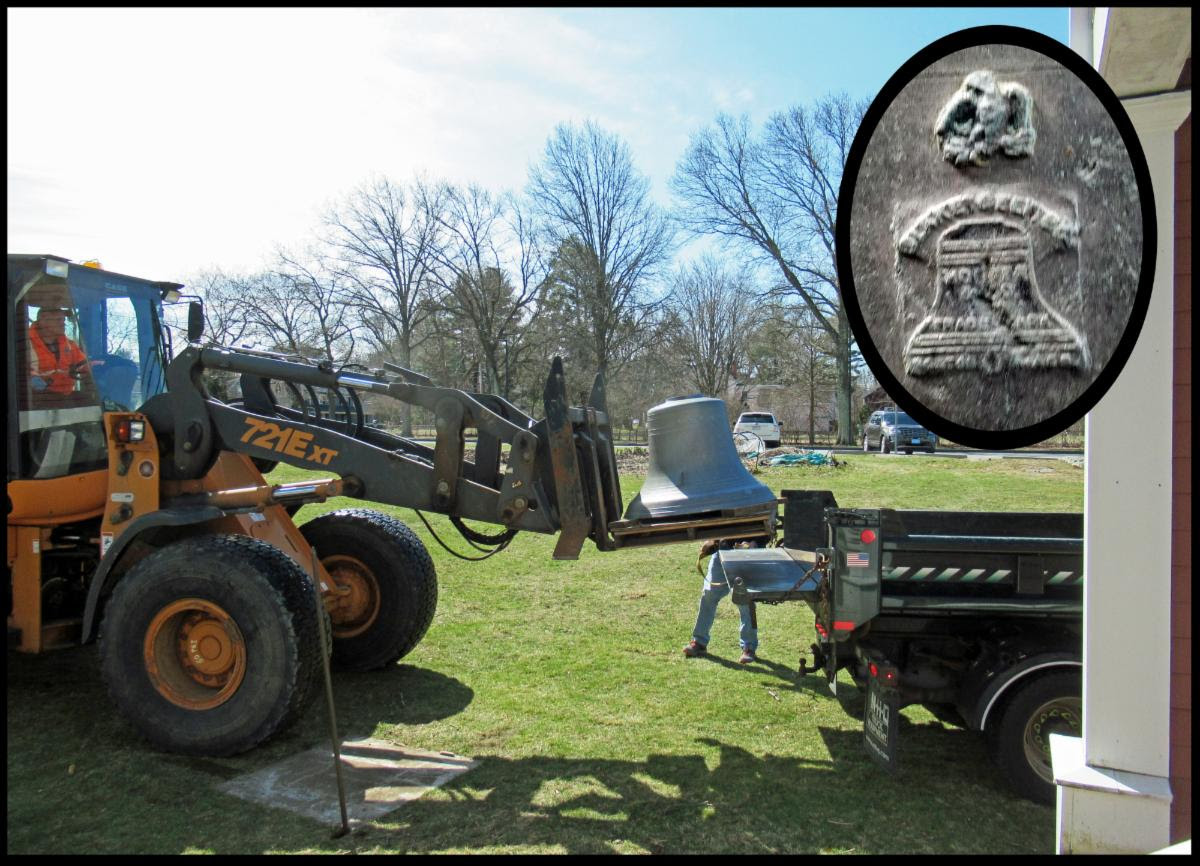
Our bell was cast in 1897, near the end of the Blake company’s life. The inscription cast around its top reads: “Blake Bell Co. Boston Mass 1897.” It also bears the company’s foundry mark, which I was delighted to see is the original Blake & Revere mark, with a bell and eagle.
After being moved from the History Center site, the bell was brought to the Jack Cogswell Building at the RTS to be weighed – 1500 lbs! Weighing it was necessary to make sure that its support brackets could safely carry it; this was not a time to guesstimate. The fire station was completed, and the bell can now be seen through the heavy glass that sheathes the tower. And although it doesn’t ring, it still resonates with the history of our town.
(*Thanks, Rob! For an informative and enjoyable discussion of Paul Revere’s innovative metalworking and his impact on the growth of American industry and economy, see Olin College Professor Rob Martello’s book, Midnight Ride, Industrial Dawn: Paul Revere and the Growth of American Enterprise. Thank you also to Carl Zimmerman (towerbells.org) for his assistance with the Blake company chronology.)
The Needham DPW crew moving the bell from the History Center’s lawn to the Cogswell Building in March 2020. The bell needed to be weighed for its support structure to be designed, and the only scales large enough were at the RTS. Inset: the foundry mark, “Blake & Revere – Hooper & Co. Trade Mark. Boston Mass.”
 |
Gloria Polizzotti Greis is the Executive Director of the Needham History Center & Museum. For more information, please see their website at www.needhamhistory.org. |