Sunscreen Dispensers to Combat Summer Sunburn

July 11, 2025
• The Needham Public Health Division re-installed free dispensers at three locations across town, with some changes.
From her office at the Rosemary Recreation Complex, town Epidemiologist Julie McCarthy watches locals head to the pool and splash pad all day in the summer — sometimes emerging with burns or tan lines.
“I do worry because people come in bathing suits or cover ups that are not covering their shoulders or their legs,” she said. “You’re never wearing a full body covering when you’re by the pool, and it’s been very hot and sunny this summer, so definitely concerned.”
A free sunscreen dispenser by the pool entrance aims to encourage sun protection, and it’s one of three scattered around sunny, high-traffic areas.
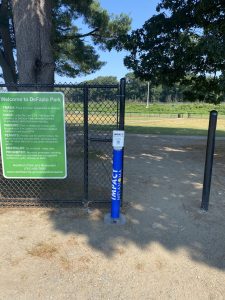
In partnership with IMPACT Melanoma, a nonprofit focused on skin cancer prevention, Needham reintroduced its public sunscreen stations at Rosemary and at DeFazio Field last week, for the third year in a row. A new, third dispenser was placed at the Town Common this year.
Paying attention to the UV index — the intensity of ultraviolet radiation — is key, said Deb Girard, executive director of IMPACT Melanoma. Even on cloudy days, sunscreen may still be necessary, she said.
“We encourage people to educate themselves with the UV index. You see it on the weather report. You see it everywhere. If it’s over 3, put on your sunscreen, wear a hat, put on some sunglasses,” Girard said. “Because even on days where the sun isn’t shining, it’s still there.”
Sunscreen should be reapplied at least every couple of hours, but more often if you’re swimming or sweating, according to guidance from the U.S. Food and Drug Administration. Experts recommend an SPF of at least 30.
The Needham dispensers returned with slight improvements: the SPF 50 sports sunscreen is now chemical-based, not mineral-based, meaning it goes on clear and blends easier, McCarthy said. Users can also pump sunscreen using a foot pedal as opposed to a hand pump. Plus, this sunscreen “smells very tropical,” McCarthy added.
The popularity of the town’s fields and use of the Town Common during lunch drove the Public Health Division to install dispensers at both locations, McCarthy said. She and Public Health Nurse Ginnie Chacon-Lopez oversee the dispensers.
“This feels like the perfect scenario for a place where someone may be in the sun for hours. You may forget your sunscreen, you may run out of sunscreen, or you may need to reapply after you applied at home,” she said of DeFazio. “The Common really came about from driving by and realizing people sit out there and eat their lunch. When you look around at the area around it, there are storefronts where people may be walking around shopping and need sunscreen.”

UV exposure, either from the sun or tanning beds, damages the genes inside skin cells, sometimes impacting their ability to control skin cell growth, leading to cancer, according to the American Cancer Society. Just one blistering sunburn during your youth “more than doubles your chances of developing melanoma skin cancer later in life,” according to the Skin Cancer Foundation.
Skin cancer is the most common cancer in the United States, but the risk of developing it reduces by 50% with sunscreen use, IMPACT Melanoma reports.
Sunscreen dispensers are one visual tool, in addition to educational campaigns, to prevent melanoma, Girard said. IMPACT Melanoma has close to 13,000 of them across the country, having installed their first batch in Boston almost 10 years ago.
“Our goal was not to provide sunscreen for every human, for every moment in time, but in fact, to provide sunscreen for when you put it on once and you’re out for the day and you need a refresher, or, in some cases, if you just can’t afford sunscreen,” she said. “[We] try to have it in parks, playgrounds, beaches, trail heads, hiking paths, any place that people really go to enjoy the outdoors.”
But sunburns happen, and if they do, McCarthy recommends hydration: drinking water and applying skin relief in the form of moisturizer and lotion. Sunburns need to heal out of the sun to avoid further damage, she said.
“If you notice you’re getting sunburned, pull yourself out of the sun. Any amount of sun damage is unfortunately dangerous,” she said. “Whether it is a red sunburn or a slightly pink sunburn. It’s all skin damage, unfortunately.”
The Public Health Division plans to keep the dispensers out through the early fall. A QR code on the dispensers lead people to the IMPACT Melanoma website.