Needham History: What’s in a Name?

Names come and go, but Nellie is eternal
 TJ Crossman’s store, in the Moseley Block, circa 1885. The store also extended around the corner on the Chestnut Street side. The cart is delivering sacks of coffee. At the time of this picture, the upstairs rooms were temporarily rented as the town offices and Town Hall
What’s In a Name?
These pictures all show a succession of general stores on the southwest corner of Great Plain Avenue and Chestnut Street – the Crossman’s/Woodruff’s/Adams’ stores in the Moseley/May/Bourne Building. The businesses and the retail block remained essentially the same for about 45 years, but the names changed for both the stores and the building as the ownership of each changed hands. Sometimes, the only way to date a picture of this corner is to identify which general store is in possession.
The Moseley Block was the second retail premises in Needham’s growing new downtown, after the small Village Hall near the tracks. It was built by Herbert Moseley in 1874, with retail space on the ground floor, and meeting and office space upstairs. At various times, the upstairs rooms held the Public Library, the YMCA, the Needham Cinema, and the Needham Town Offices. At street level, the shops included clothing and dry goods stores, drug stores, tobacconists, the Post Office, and always – a General Store.
The earliest of the general stores was T.J. Crossman & Company. The Crossman family came to Needham in 1873. Thomas Crossman opened a grocery and general store in the Moseley Block around 1884. The store sold “Groceries, Flour & Grain,” as well as painting supplies, canned goods, cleaners, and the like. General stores were exactly that – stores that sold a wide and not necessarily related range of goods. There were also specialty stores and tradesmen aplenty – fish stores, butchers, shoemakers, etc – but general stores were the main supply stores for a village like Needham. People did not have a lot of options, and it was not easy or convenient to travel from town to town to do your shopping. The store did the “traveling” for you, by bringing in a range of necessary goods from manufacturers, suppliers, and middlemen to a single and convenient location.
Crossman’s moved out of the Moseley location in 1888. They re-opened in 1893 one corner over (the former location of Harvey’s), where they remained as a familiar downtown presence until about 1960. In 1889, the Moseley Block was sold to H.L. May and was renamed the May Building. The old Crossman’s location was taken over by Dawson & Woodruff (“Dealers in Choice Family Groceries. Also, flour, teas, patent medicines, crockery, hardware, farming tools, cutlery, stationery, small wares, etc.”). By 1896 Dawson was gone, and the store was run as A.L. Woodruff & Son (“Dealer in Groceries and General Merchandise. Also agents for Essex Fertilizers, Bradley’s Fertilizers, and Pacific Guano Fertilizers.”) The proprietor of Woodruff’s store was not A.L., but the son, Charles. Charles thought big; not only did he expand into guano sales, but he opened a second store on Highland Avenue in the Heights, so he had a general store in both sections of town at once.
Clearly, Woodruff’s big plans took him elsewhere (or out), because by at least 1911 the store belonged to the Adams brothers – George, Harry, and Walter. George Adams started out selling fish, right around the corner from Woodruff. George and Harry lived in Needham, and Walter lived in Medway. In addition to the Needham store (in the newly-renamed Bourne Building), they had a second store in Dover. They sold “Fine groceries and general merchandise. Gasoline, oils, and tires.” Plus lawn mowers, Old Dutch Cleanser (“Chases Dirt”), La Touraine (“the Perfect Coffee”), Quaker Oats, and Sherwin-Williams Paints (“Cover the Earth”). As the stores changed, so did some of the merchandise, to keep up with the demands of the modern world.
Top: A.L. Woodruff’s store, circa 1900. From left to right: Charles Woodruff, Nellie Burkett, Thomas Graham, —– Beckwith, Robert Graham. Signs in the windows advertise Bon Ami Cleanser (“It hasn’t scratched yet!”), Quaker Oats, and Pride of Virginia Cut Plug tobacco. In 1889, the building had been purchased and renamed by H.L. May.
Bottom:The interior of Woodruff’s store, showing the range of merchandise, including Salada Tea, Heinz Pickles, Sunlight Soap, and Carters’ laundry bluing. Nellie Burkett and Charles Woodruff are minding the store. Charles, was Nellie’s brother-in-law, married to her sister Gertrude.
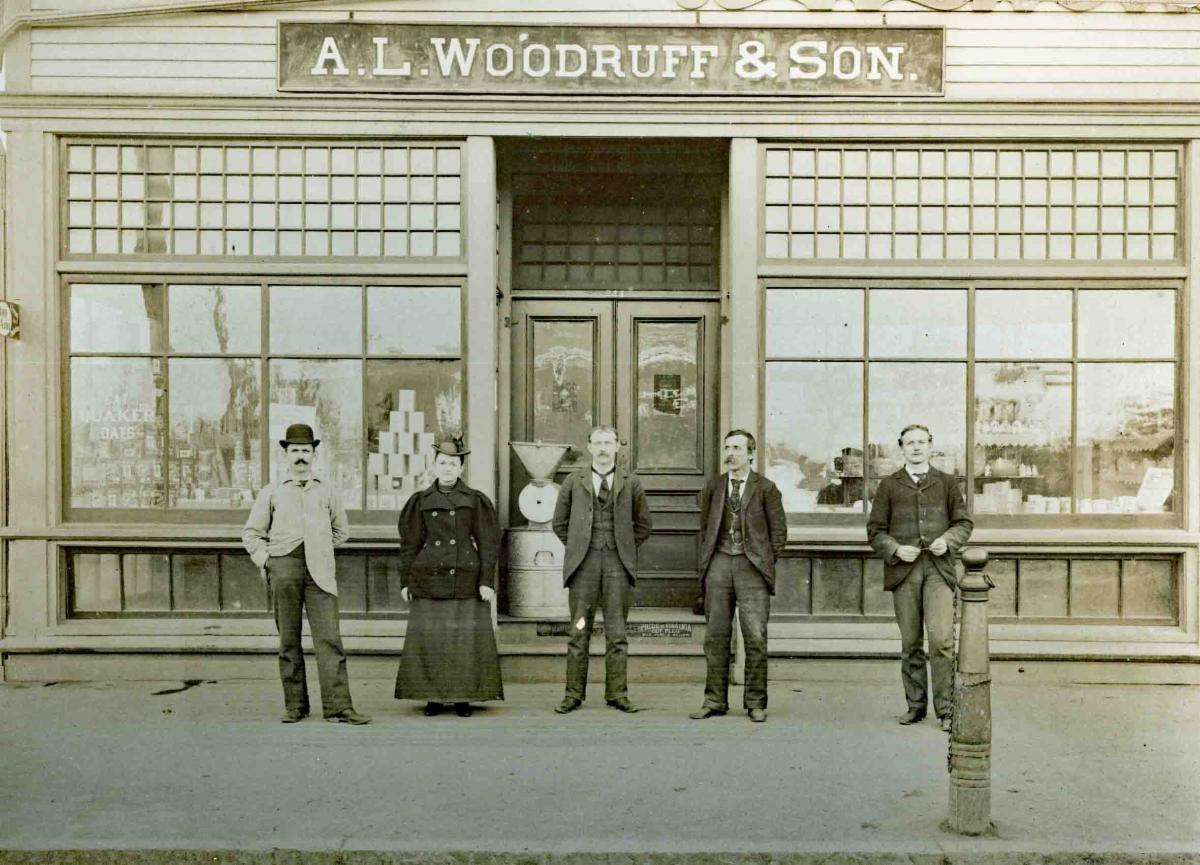
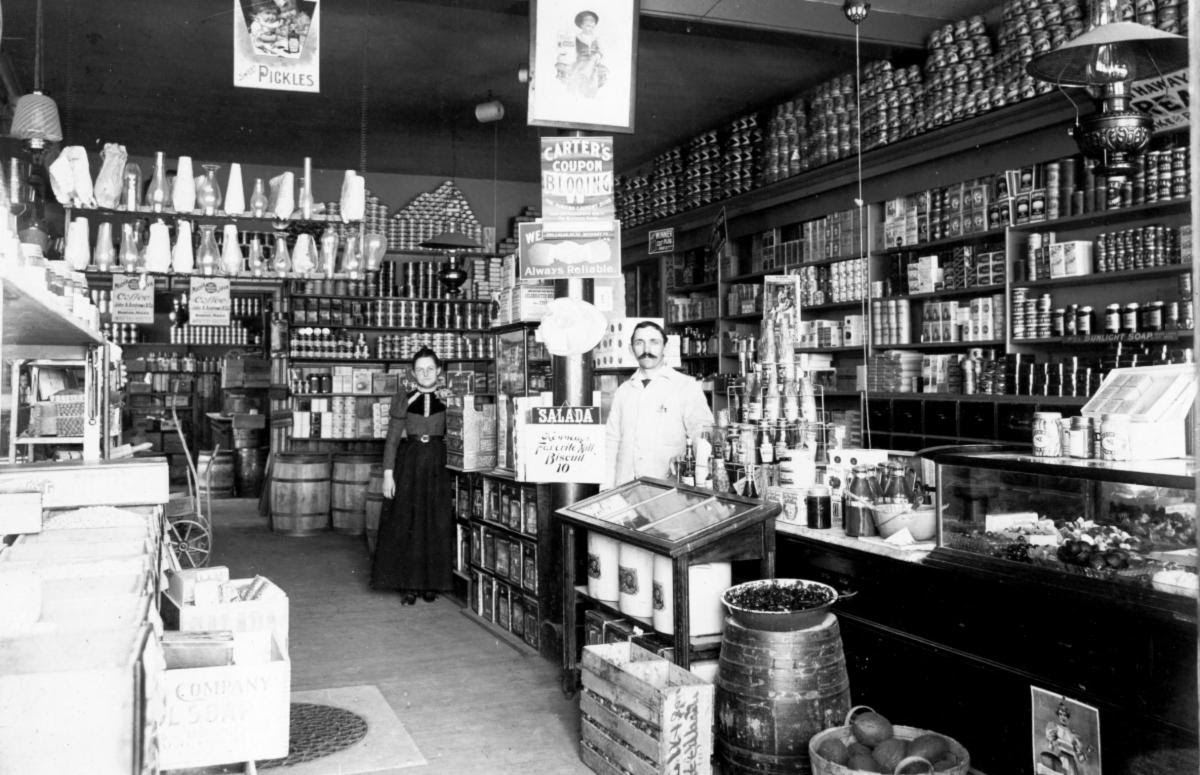
Well, proprietors come and proprietors go, but apparently there was one constant on this corner – Nellie Burkett. Nellie Burkett is seen in both Woodruff’s pictures, and several years later is also in the Adams Brothers picture. Nellie was born in 1871, and lived nearly all her life in the house she was born in, on Highland Avenue. As the Great Plain began to develop as the town center, the lots near Great Plain Avenue were considered to be highly-desirable residential locations. Nellie’s father, Captain Gorham Burkett, built a rather lovely house in 1867 on the location that is now the Walgreen’s parking lot. Capt. Burkett was a merchant seaman. He went to sea as a youngster, and eventually rose to become Captain. He sailed to China, India, Australia, and the Philippines, among other Pacific destinations. On one trip, he brought Nellie and her sister Gertrude a beautiful lacquered sewing table, filled with delicate ivory spindles, bobbins, and other tools and decorated with scenes painted in gold. (This sewing box now belongs to the Needham History Center, and is on display).
Nellie was a graduate of Needham High School, Class of 1890. She never married, and worked all her life as bookkeeper and clerk for Woodruff and Adams, as well as Willett and Chadwick’s Coal and some others. In 1953, when she was around 82 years old, she sold the Highland Avenue house and moved down the block, to an apartment on May Street. The house was soon torn down, and the lot was used for manufacturing businesses prior to becoming a parking lot. Nellie celebrated her 90th birthday with friends in 1961, and passed away in 1968 at the age of 96.
As automobiles became more common and people became more mobile, the general stores died out. It was easier for businesses to obtain the goods they needed to specialize, and easier for customers to reach them. Changing retail also brought an end to the Moseley Block, which was torn down in 1928 to make way for the current one-story retail row.
Officially, that building is the Barkin & Gorfinkle Block, and as far as I know has never changed names.
Adams Brothers store, circa 1915-1920, in what was then known as the Bourne Building. Nellie Burkett is in the doorway. The other four men are not identified, but this image was used for a store ad, so no doubt at least two of them are George, Harry, and/or Walter.

 |
Gloria Polizzotti Greis is the Executive Director of the Needham History Center & Museum. For more information, please see their website at www.needhamhistory.org. |