Needham History: The Accidental Artist

He probably thought of himself as a builder, or a shopkeeper.
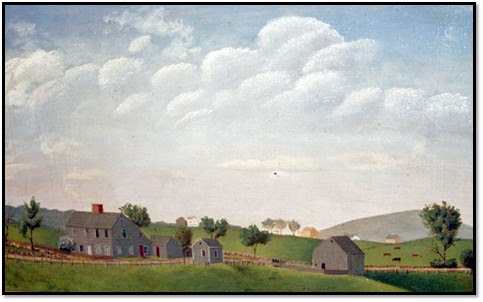 A view of the Robert Fuller House (1707), at the corner of Forest Street and Burrill Lane. The hills in the near background are now the location of Babson College and the Wellesley Country Club. The Fuller house is the oldest standing house in Needham, and remarkable in that its original saltbox structure has never been significantly altered. Smith made this painting in 1861, at a time when Needham’s hillsides were still cleared for farming.
Timothy Newell Smith, the Accidental Artist
There are names in Needham’s history that I hear over and over, until they feel like old friends. Eventually I try to find out more about them, to find what information we might have that accounts for their recurring claims on my attention. Sometimes I find a lot – as in the story about Antonio Courante. Sometimes, not as much as I had expected – as in this case, of Timothy Newell Smith. As a result, this may be more of a photo essay than a story, because we have more pictures by him than facts about him. Nevertheless, I’ll give it a try.
Timothy Newell Smith (1817-1893) was the son of Newell Smith and Catherine McIntosh. His father’s family arrived in Dedham by at least the mid-1600s. In 1701, his great-great-grandfather John Smith moved into the land north of the Charles River, and established his homestead near where South Street and High Rock Street now converge. In his time, John acquired a great deal of land, and also fathered six sons to pass it on to. Three of these sons were signers of the Petition that separated Needham from Dedham in 1711. The family prospered and expanded, and by the time that Timothy Newell came along in 1817, there were great many Smiths in Needham. (There was also at least one other important Smith family, that of James Smith and his son Captain Robert Smith, but they were not related).
Smith’s mother’s family were relative newcomers – Catherine McIntosh was the granddaughter of Needham’s Revolutionary War hero, Colonel William McIntosh. Col. McIntosh came to Needham in the 1750s, purchasing land on what is now Great Plain Avenue near the Wellesley line. Newell and Catherine settled in a house on Central Avenue, near what is now the entrance to North Hill.
I can find very little about Timothy’s personal life. According to Ancestry.com, he had six children, but details about them are few. I have not been able to find the name of his wife. Based on the listed information, it looks like two of the children may have died as infants, two as young adults, and only two making it into middle age. There is also a 25-year age difference between the first child (Eveline, born 1855) and the youngest (Paul Byrd, born 1880), suggesting that Timothy married twice. According to the 1856 Walling map of Needham, Timothy lived on Central Avenue right about where Bess Road is today, and right across the street from his parents’ house. Later in his life he moved to West Needham/Wellesley, which is where he died in 1893.
Like many local men of his generation, Timothy Newell Smith had several occupations. Few people had A Job; most just used the skills they had to get by. Timothy’s skills mostly involved building. In 1855 he was the builder for the new schoolhouse on Great Plain Avenue, and in 1857 he built a barn for the town meeting hall. In the 1850s, he and his brother-in-law Ezra Fuller Jr owned a general store on the old tavern site at the corner of Great Plain and Central Avenues. In 1860, he is listed as the owner of a lumber yard next to the train tracks on the south side of Great Plain Avenue (the area behind Copley Motorcars, Learning Express, and Needham Garden Center).
Smith also did his part to serve the town. He was a member of the building committee overseeing the construction of the old Center (later Dwight) School in 1845. In 1825 he was Captain of the East Needham Militia, and was commander when the East Company represented Needham at the laying of the cornerstone for the Bunker Hill monument that same year. He was a Captain of a later militia corps, the Needham Rifle Rangers, in the 1840s. He served as Selectman from 1849 to 1851.
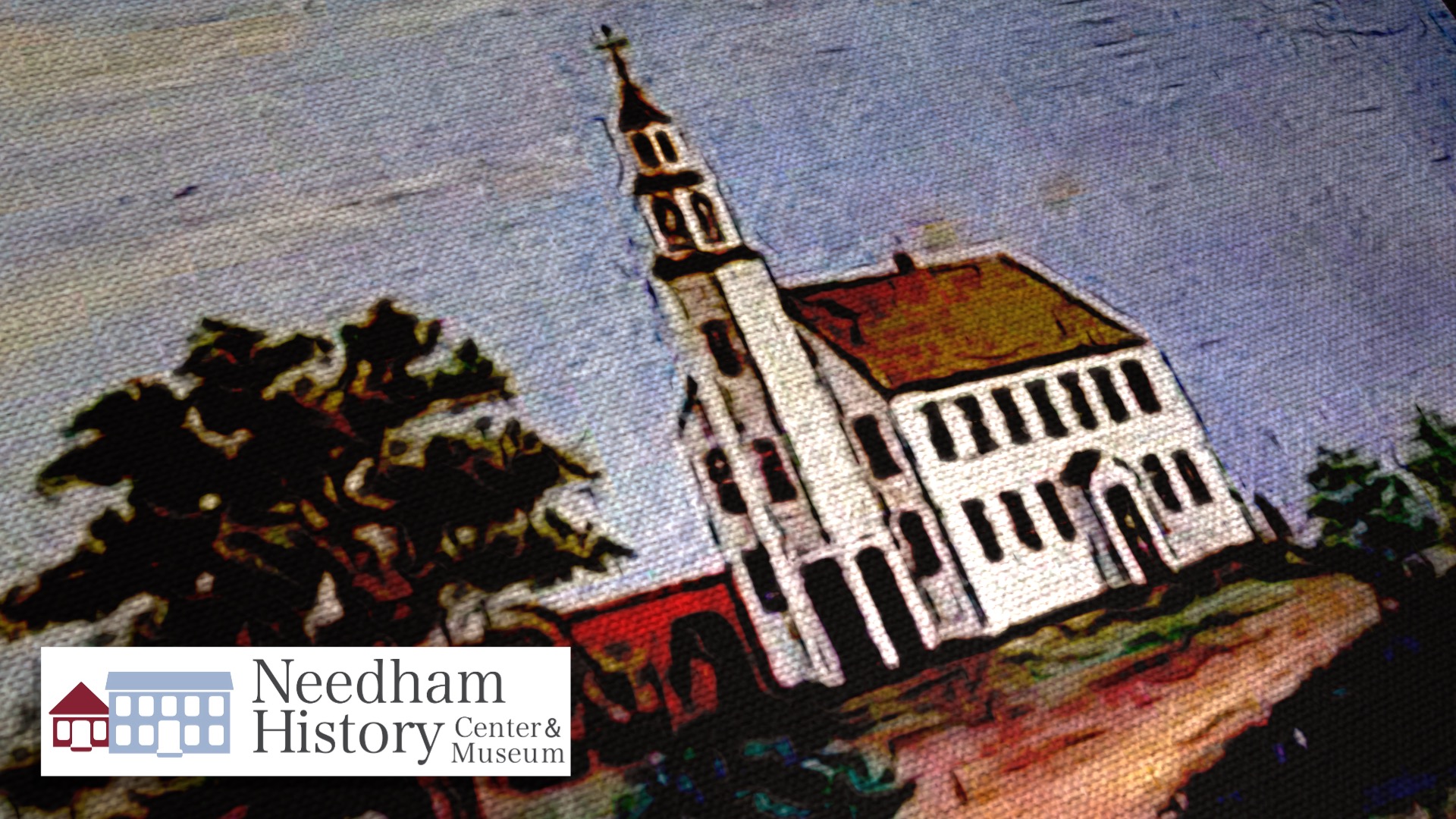
But Timothy Newell Smith’s most endearing talent, the one for which he first attracted my attention, was his skill as an artist. And not just an artist – an artist who specialized in recording Needham scenes and historic buildings. There are numerous sketches, and at least three paintings that I know of; most are in the History Center’s collections (yay!), and a couple are in private (but also local) hands. The most widely-seen is probably the painting of the First Parish and the old center, which hung for many years (and still does, I believe) in the foyer of the First Parish Church.
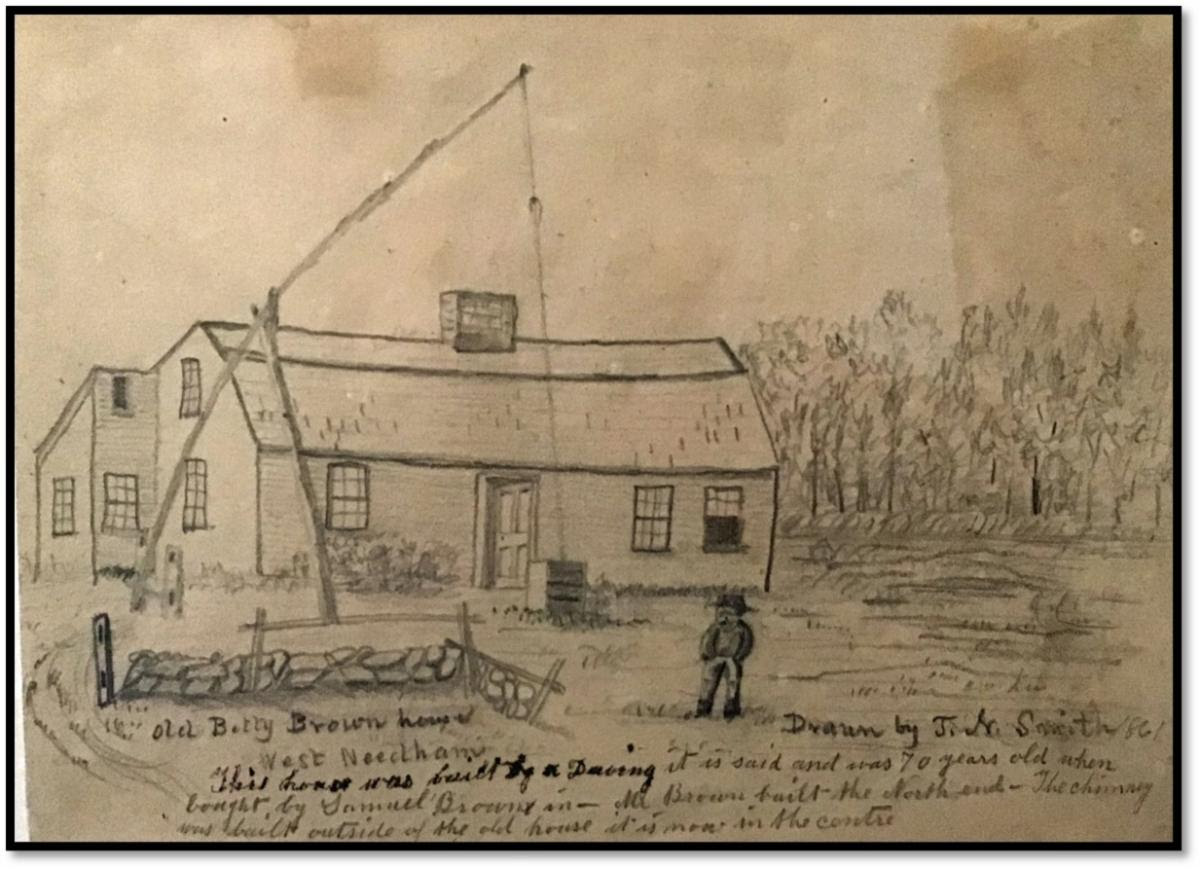
Top: The Betty Brown House in West Needham (on what is now Brook Street in Wellesley), drawn in 1861. The house was built in the 1600s, and has since been demolished.
Bottom: The First Parish church and the old Center of town as it looked prior to 1835. Painting by Timothy Newell Smith. This hangs in the lobby of the First Parish church.
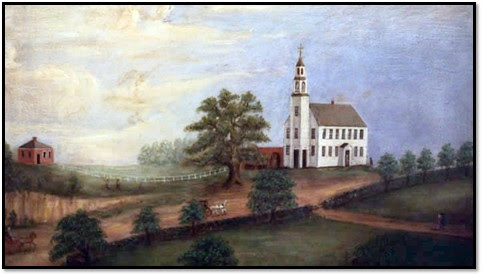
The History Center has a small painting that he did of the Robert Fuller House on Forest Street at Burrill Lane (above). The house, built in 1707, is the oldest standing house in Needham. When he painted it in 1861 there were a few surviving older houses, but not many. The painting shows a Needham scenery that is now unfamiliar to us – cleared land with cattle grazing on the side of North Hill. Most of our land had been cleared for farming in the 18th century; this woodland that we are so used to is secondary growth from the last century, after farming declined. Those rolling hills are now the location of Babson College and the Wellesley Country Club. The white house at the crest of the hill might (might? maybe?) be the old Town House (meeting hall).
We have several framed sketches that Timothy made of houses that were ancient even in his day, such as the Betty Brown house (above). All of these are now gone, of course, and his drawings are our only record.
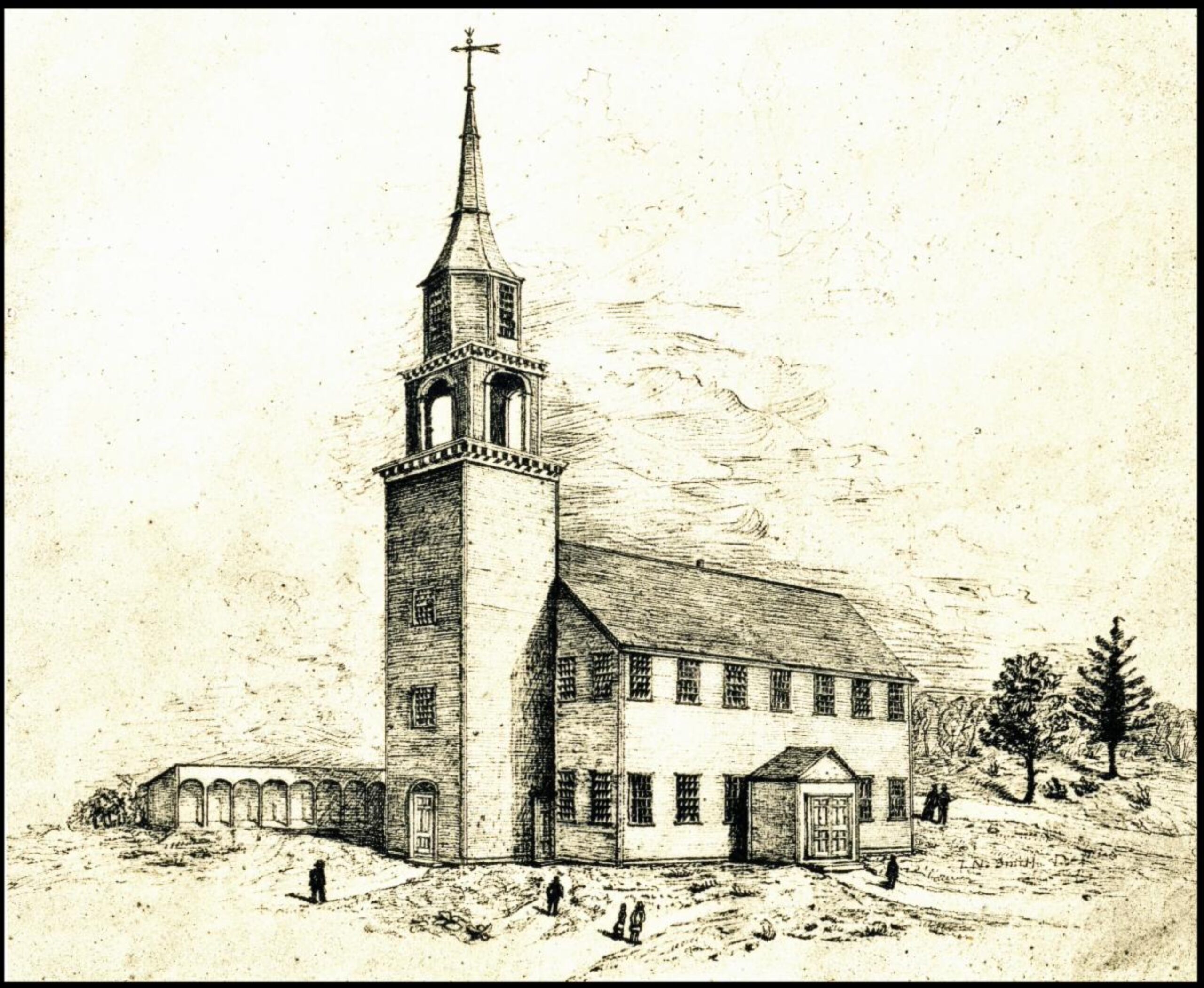
We also have a small sketch of the second structure of the First Parish Meeting House. This was built in 1774 after the first structure burned down, and was demolished in 1836 when it became unstable due the addition of a large steeple to hold the Centennial (Paul Revere) Bell. He made a rough sketch of the first meeting house as well, and several plans of the interior with the pews and seating. These last must have been made by consulting with some of Needham’s old-timers – the first meeting house burned down long before Timothy was born, though the second meeting house (prior to steeple) was a near replica. He also made a lovely pastel sketch of the third (current) First Parish church; we have a photo of this, but the original is owned (alas!) by our friends at the Wellesley Historical Society.
Timothy Newell Smith was not a trained artist, but he had a good eye and a good hand. His sister, Catherine Smith Fuller, was also a talented artist. If I had to guess, I would say that they were taught by their mother, Catherine McIntosh Smith. Both Timothy and Catherine Fuller had their own pupil – Catherine’s son Timothy Otis Fuller. Timothy Otis’ skill is displayed in his wonderful bird journals (also on view at the Needham History Center), and his talent surpassed that of his teachers.
Timothy Newell Smith probably thought of himself as a builder, or maybe as a merchant storekeeper. It is unlikely that he thought of himself as An Artist, and it is certain that he never made money from his drawing. We are grateful, nevertheless, for his talent, which enables us to see glimpses of a Needham long past, and that could have been preserved in no other way.
A sketch of the second structure of the First Parish Meeting House. This was built in 1774, after the first meeting house burned down. The steeple was added in 1811 to accommodate the new Paul Revere bell, purchased for the town’s centennial. However, the large steeple destabilized the structure, and it had to be taken down and replaced in 1836.
 |
Gloria Polizzotti Greis is the Executive Director of the Needham History Center & Museum. For more information, please see their website at www.needhamhistory.org. |