Needham History: “The Experiment Promises to be Very Satisfactory”

America’s farms were the unlikely destination for thousands of POWs
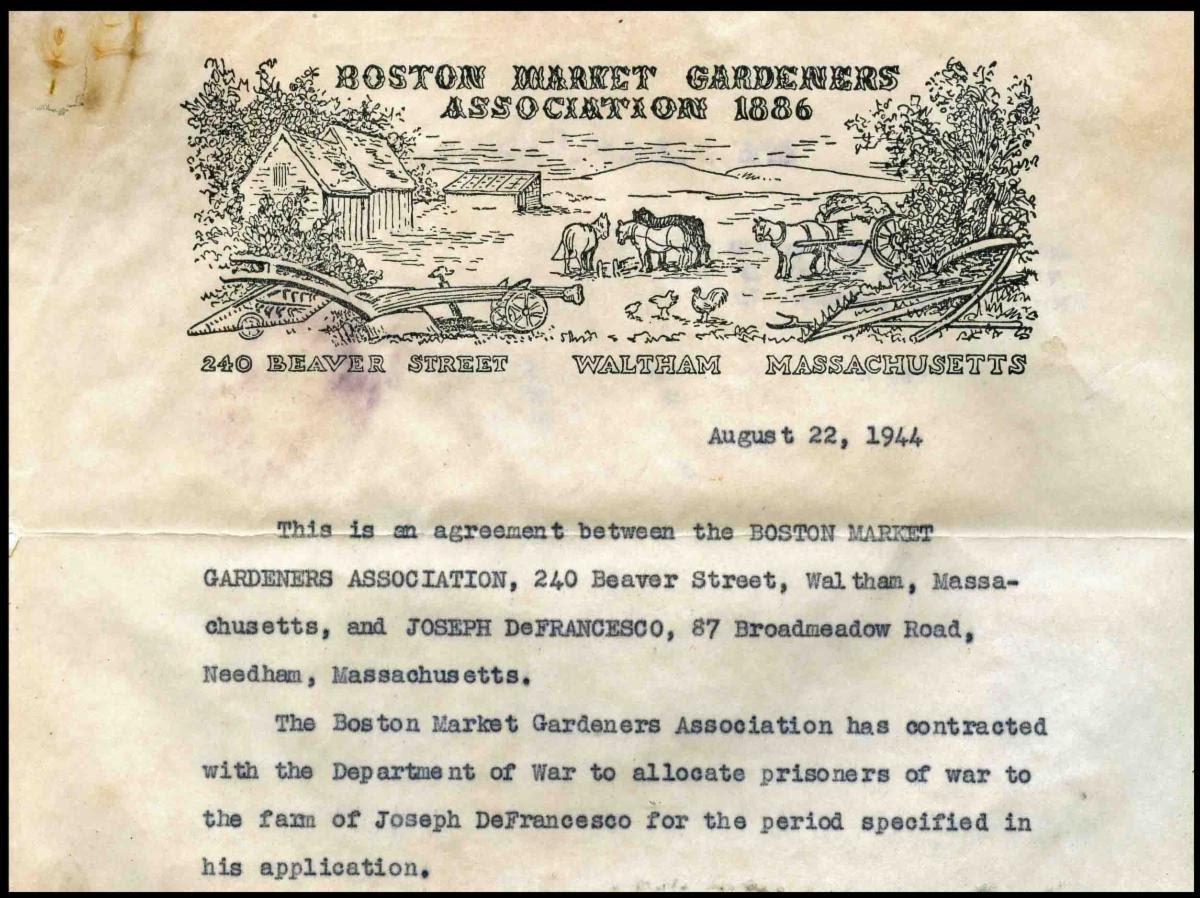 Detail of agreement letter between the Boston Market Gardeners’ Association and Joseph DeFrancesco of Needham for the use of POW labor on his farm, 22 August 1944. Both the original and the carbon were still in the envelope.
“From all reports, the experiment promises to be very satisfactory.”
Surprises come in all forms. I recently received an envelope in the mail, sent to me by Andy Garlick, Principal at the Broadmeadow School, containing a sheaf of papers that he found in his office desk. The papers were an agreement and memo between the Boston Market Gardeners’ Association, acting as agent for the US Government, and Joseph DeFrancesco of 87 Broadmeadow Road in Needham for the employment of German POWs on DeFrancesco’s farm. The agreement was dated 22 August 1944.
I had known that German POWs worked on American farms; I knew a German gentleman who had worked on a German-American potato farm in the Midwest, and stayed on to become an American citizen. But I was not aware that POWs had also worked in Needham.
America’s farms were the unlikely destination for thousands of POWs during World War II. As the numbers of German and Italian prisoners grew, our European allies were running short of secure locations to house them. Between 1942 and 1945, more than 400,000 prisoners were sent to the United States, to approximately 500 prison camps mostly in the South, Southwest, and Midwest. In these camps, the POWs were well away from the fighting and their countrymen, and from the temptation to escape. (Overall, only 2,222 of the 400,000+ prisoners in American camps tried to escape, and most were quickly recaptured).
The American POW camps not only provided relief for the Allies, but they also provided a solution to another pressing problem. Because of the large number of men of working age who were enlisted in the armed forces, and because of the increased need for wartime food production, there was a severe labor shortage on America’s farms. The availability of prisoners became a solution to the farm labor crisis.
Although there were initial fears about putting enemy soldiers to work in the communities, these fears were short-lived. Committed Nazis, estimated to be about 10% of the prisoner population, were segregated into separate camps, and not included in the work programs. Most of the prisoners in the labor program were young, mostly farm boys themselves, who showed no strong affiliation to the Nazi Party. Most were sent to the states with large German-American populations, where they would feel more welcome and also would be subtly indoctrinated with democratic values by voices whose language they understood. Troublemakers—those who attempted to incite escapes or who resented working for the Enemy—could be confined for a few days on bread-and-water rations, or were sent away to one of the camps for pro-Nazi prisoners.
The US Government established strict requirements for both the work and the treatment of the POW laborers. Under the Geneva Convention, officers could not be forced to work. POWs could not be put to work under hazardous conditions, and they were not permitted to work in jobs or industries related to the war effort. They had to be paid for their labor, and provided with sanitation, meals, fresh water, and periodic breaks. Employers paid the Government 45 cents an hour per worker (roughly $7 per hour in current value) and the prisoners were paid up to 80 cents per day ($12.50); this was enough to put some money in their pockets for small purchases at the camp canteen. As a comparison, the federal minimum wage that had been established under the Fair Labor Standards Act of 1938, was 30 cents/hour in 1944. However, then as now, the actual paid rate was higher, reflecting the high demand for labor.
Although most of the POW camps were in the South and Midwest, there were camps in other parts of the country, including eleven in Massachusetts. Among these was Fort Devens in Ayer, which held special status as one of three camps designated for “Anti-Nazi” prisoners—mostly prisoners whose divisions had rebelled against or resisted German commands, or who had come from conquered territories. From February 1944 until May 1946, Fort Devens held 4500 German and 500 Italian prisoners. The POWs worked in camp at kitchen duty or repairs, and also on local farms. Col. Howard G. Storke, commander of the POW camp at Fort Devens, approved the farm labor program, which was implemented by the Boston Market Gardeners’ Association. The BMGA was founded in 1886 to conduct agricultural research and to address issues of importance to the small farmers in eastern Massachusetts.
According to his contract, DeFrancesco was to pay 55 cents ($8.70) per hour per man for an 8-hour day. The prisoners were assigned in groups of ten. The agreement also stipulated the following:
1. The farmer would provide a safe truck with plank seats for transportation, arriving at Fort Devens promptly at 7:00 am and returning the prisoners no later than 6:00 pm. An eight-hour day was suggested, and a lunch break of 30-60 minutes must be provided. Prisoners would bring their own lunches.
2. The farmer must be “on the spot” to receive the prisoners when they arrived at his farm for work.
3. The farmer would provide Fort Devens with a complete description of the driver of the truck—age, weight, height, hair color, eye color—and anyone who did not match would not be admitted.
4. The POWs may not mix with civilian labor other than supervisors and overseers, and “in particular, female help must be kept away” from them.
5. The farmer must provide clean drinking water, and toilet facilities with “decent concealment.”
6. Guards were on duty from the time the prisoners were picked up until they were returned. They were paid for by the Army, and were only for security; they did not supervise the work.
7. Any man who shirked his work or proved objectionable in any way would be reported to Col. Storke immediately.
8. And finally – “It is likely that you will be visited or telephoned by newspaper reporters. Give them no information whatsoever. If you do, it is certain to be distorted or sensationalized. You may very likely be embarrassed when it appears in print. The guards will see to it that no photographs are taken.”
This last point is especially interesting. When Joseph DeFrancesco applied for laborers, the program was brand-new. The first BMGA contract with local farmers was with two farms in Concord, and had only been executed on August 7th—just two weeks before. The BMGA found the results to be “very satisfactory,” and Col. Storke “showed a fine spirit of cooperation and was determined that the project should succeed.” The program did succeed—it was continued and even expanded to other parts of the state by the end of the year. Even so, while pragmatic, it was also still unproven and controversial in August 1944.
A copy of DeFrancesco’s application was not preserved with these papers, so we do not know how many workers he requested, or for how long. But going through the papers, I noticed that the agreement may never have been carried out. The memo from Ray Koons, Secretary of the BMGA, notes that two copies were sent, and that one should be signed and returned. Both the original and the carbon are still in the envelope. Did DeFrancesco have second thoughts? Was the cost too high? At $4.40 per man per day, times 10 men per group, he would have been paying $44 per day (nearly $700 today) for each group. Or maybe he decided that “very likely being embarrassed” was not worth the trade-off. You can avoid newspaper reporters, but you have to live with your neighbors.
Joseph DeFrancesco sold his farmland to the town in 1949, and it became the site of the Broadmeadow School. The papers were sent to Broadmeadow School a few years ago by the family who had purchased the DeFrancesco’s home (and I assume, found them in the house), in the hope that they would “become an important part of the school’s and surrounding land’s archival history.” Indeed they have—and thank you!
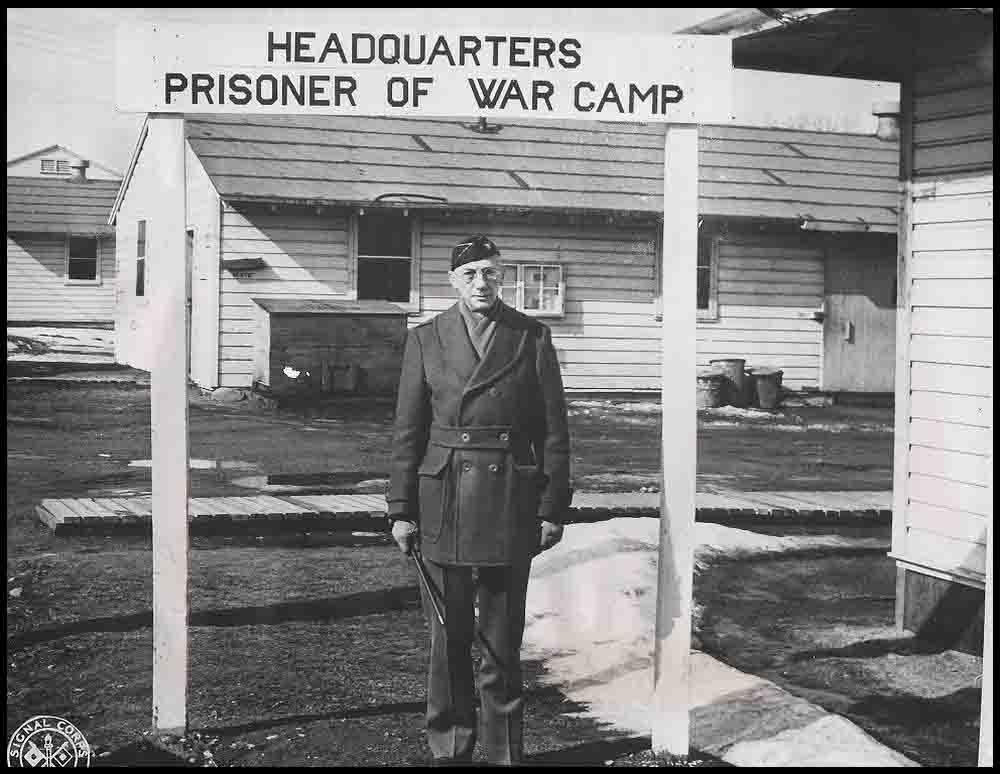
Col. Howard G. Storke, commander of the POW camp at Ft Devens
 |
Gloria Polizzotti Greis is the Executive Director of the Needham History Center & Museum. For more information, please see their website at www.needhamhistory.org. |