Needham History: Some Account of Parish Visits

Rev. West had his work cut out for him.
 A sketch of the First Parish Meeting House, by Timothy Newell Smith.
Some Account of Pastoral Visits in 1775
by the Rev. Mr. Samuel West, Minister in Needham, 1764-1788
Poor Samuel West! An earnest and hardworking young Minister, taking over the Needham pulpit from the Rev. Jonathan Townsend, who had been the town’s first Minister, and incumbent for 43 years. Big shoes to fill, and in your first job! When Rev. West was called to the Needham pulpit, he was newly-ordained and only 26 years old.
West inherited an unruly town of about 950 people. And he was not impressed.
“June one thousand seven hundred & sixty three I was invited to preach as a candidate, to ye people on Needham. Never man was more disgusted either with place or people than I was on my first visit, and if anybody could have assured me at that time that it would be my residence during ye best part of my life, it would have given me ye most painful impressions.
The town is extremely broken, and although the soil is in some parts good, it is in general thin hard and unproductive. There is no considerable road through it and ye middle of ye town especially is thinly settled retired & obscure and dreary as a wilderness. The people were extremely rude and uncultivated owing especially to their situation with respect to ye capital which was not near enough to render ye market profitable & yet was so near as to prevail on them to make it their principal object.”
He goes on to note that the farmers dedicate their labor to felling trees for lumber, which is not profitable, at the expense of the dairy cattle that would be their best chance of prosperity. They also have a “habit of intemperance,” which consumes (a pun!) their profits to the detriment of their families. He does mention that there are several who have avoided excessive drink, and they are managing their farms to a profit, and that they “constitute ye most respectable part of ye town. There was indeed and is still a number of this description with whom I formed ye most intimate friendship & and for whom I always had & still retain a high esteem and sincere affection.” (How do we know all this? Rev. West wrote a memoir of his life, and we have a transcribed copy!)
Samuel West had envisioned a more cosmopolitan life for himself. He had received his Divinity degree from Harvard, and enjoyed the city life of Cambridge. Nevertheless, and despite his “disgust with place and people,” Rev. West reluctantly accepted the call to take Needham’s pulpit. He did this for two reasons – the first, is that his father (also a minister) considered Needham’s unanimous approval to be the voice of Providence, not to be lightly dismissed. And the other was that he needed the money – he wanted to send his younger brother to college, and the settlement (133 pounds, six shillings, and eight pence) with an annual salary of 73 pounds and change, was enough to allow him to do this. Even so, he did not at first think of it as a long-term plan: “When I gave my answer, I could hardly persuade myself that it implied a permanent residence in ye town. But habit soon in a measure wore off my disgust, and I was treated with great kindness by the people in general, gave myself up to ye duties of my office and soon found pleasure in ye seclusion from society which at first seemed so disgusting.”
West’s tenure in Needham coincided with some of the more exciting parts of our 18th-century history, including the unrest that resulted in the burning (arson) of the Meeting House, and the start of the Revolutionary War. Thanks to his extensive and candid memoir, we have a good first-person record of the events that took place in Needham during these turbulent times.
Despite our general impression that Puritans were all sober and religious, this was not the case for Rev. West’s parish. There were indeed sober and religious people here, but there was also a growing disparity in practice. There were several reasons for this. First, the church itself was undergoing changes from the strict Puritan/Congregationalism of the 17th and early 18th centuries toward the more liberal Unitarianism. There were also still echoes in Needham of the Great Awakenings of the earlier 1700s, that emphasized a more emotional and “personal” conversion and challenged the established church; Rev. Townsend was a mighty opponent of this movement in Needham, but lamented that some of his parish were attracted to its teachings. And finally, that some people were just slackers; church discipline was hard, with long weekly attendance, Bible study, etc, and many did not make time for this in their daily lives.
In addition to Rev. West’s memoir, he published a number of tracts and sermons, but more interesting are some manuscript notes he left on his daily work, Some Account of Pastoral Visits in 1775. A minister was responsible for the spiritual (and often bodily) health of his parishioners, and so his daily work often included visiting the homes of backsliders, drinkers, etc. to offer The Word in Good Season. This often meant an appeal to their wives to exert beneficial pressure for the sake of the children, or to the children themselves if he felt that the parents were shirking their duty to bring them up in a Godly manner.
Janry ye 3d 1775: Visited Mr Nathaniel Dana’s family. Conversed with ye children. Urged them to remember God in Days of Youth. Endeavored to guard and caution them against ye Snares to wch Childhood and Youth are particularly exposed. Impressed on them ye importance of fervent prayer and due Care to Sanctify ye Lord’s Day… Then conversed wth ye Heads of ye Family. Endeavored to Encourage them in Steady Practice of Religion in general, and urged on them a serious Consideration of ye Shortness of Time, and ye danger of an undue attachment to ye things of this world. Lent them Burket’s Poor Man’s Help for a month. Prayed with them and took Leave.
Feb 14: Visited Mr Nathaniel Gay, Sr. Admonished him for ye Sin of Intemperance towrd which he has been much addicted. For his freqt neglect of family prayer urged upon him Reformation in these things, as well as a serious regard to ye Concerns of his Soul in general. Exhorted and Counselled his Wife and ye Children… They seemed to be serious and attentive. They asked me to pray with them, which having done, I came away.
Feb 14: Visited Mrs Durant’s family. Discoursed with all ye members of it distinctly. They seemed to be in a serious good home. Some of them I thought discovered great acquaintance with experimental [ie, unorthodox] religion. Encouraged and exhorted them to cleave to God with purpose of heart. Lent them Law’s Serious Call. Prayed with them.
West’s Account, even more than his memoir, is a good record of the trials and tribulations of a small town minister in the 18th century. Unlike the larger issues noted in his memoir, or even the matters raised in the weekly sermon, the Account shows West in his daily slog – admonishing the wayward (and I can only assume that Mrs Gay asked him to drop by, because his words would have more weight); making sure that children were being raised with religion; and even for devout families like the Durant’s, keeping them on the path of Orthodoxy.
Samuel West left Needham in 1788 to take the pulpit of the Hollis Street Church in Boston. This was a significant promotion in both prestige and salary. The parish was not pleased, and many blamed Mrs West for convincing West to pursue Prestige in Boston rather than Souls in Needham. There is some truth in this – West had refused other calls to leave Needham, but Mrs West was in favor of this move. But there were other issues. Needham was lax to the point of neglect when it came to paying the minister his salary. Some years they paid only part; some years they did not pay at all. The Wests were trying to keep a home and raise and educate four children, and funds were chronically short because their income was so inconsistent.
Hollis Street did indeed bring Samuel West prestige, and he came to be considered one of the “pioneers” of Unitarianism. However, thanks to his time in Needham and the notes he kept, we have an intimate view of daily life and community concerns in Needham in the years around the Revolutionary War.
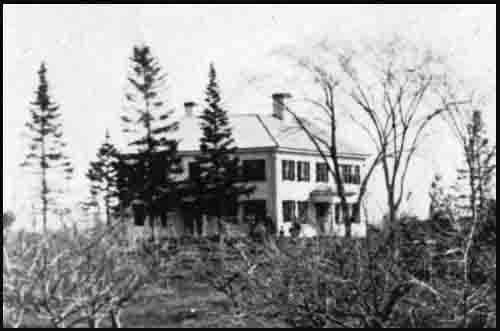
The Parsonage, as it appeared when Samuel West lived there. The house was built for the first Minister, Jonathan Townsend, in 1720. The house is still standing at 980 Central Avenue, though the mansard roof is an 1870s alteration.
 |
Gloria Polizzotti Greis is the Executive Director of the Needham History Center & Museum. For more information, please see their website at www.needhamhistory.org. |