Needham History: Long and Winding Roads

What is the Oldest Road in Needham?
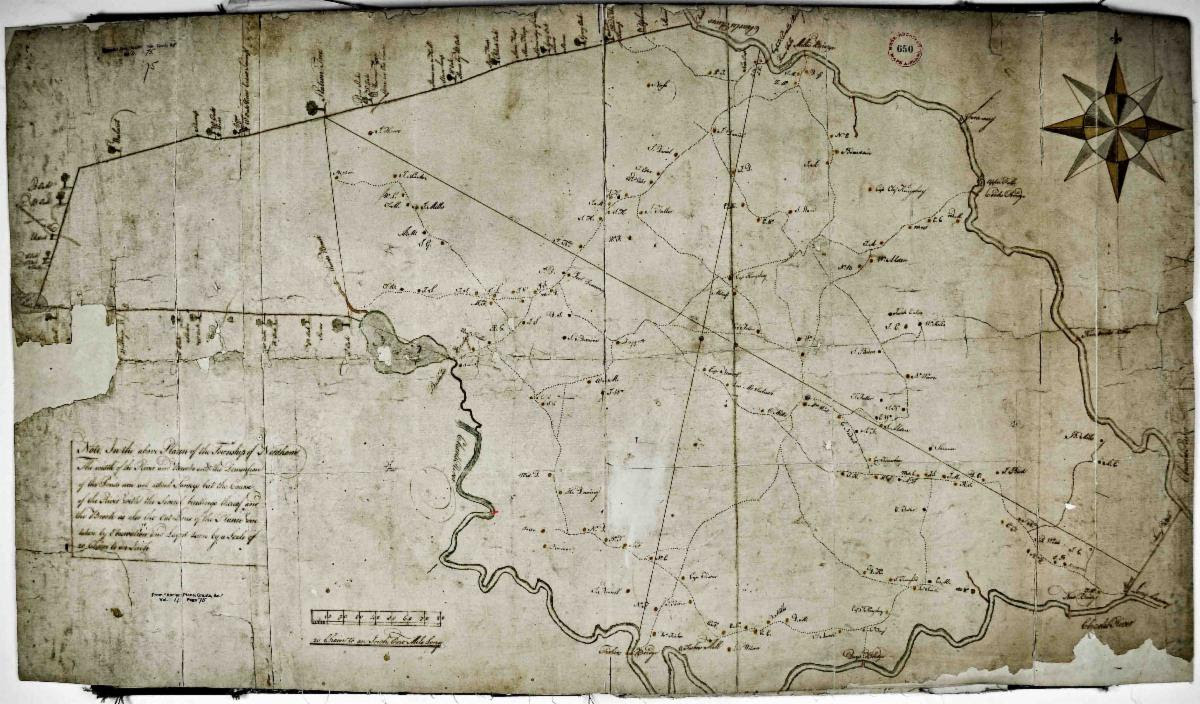 The Barachiah Mason map of Needham, 1771. Each dot represnets a house and is labeled with the name or initials of the owner. The map shows how few roads and houses there were in town at the time of the survey.
Long and Winding Roads
If all roads lead to Needham… what about the roads that are already IN Needham?
A couple of months ago I had a note from Tyler Gabrielski, the Director of Streets & Transportation at the Needham Department of Public Works. He had just gotten an email from a woman whose 8-year-old grandson had some questions about Needham’s roads. Tyler had the modern data, and I had the historical data, so between the two of us, I hope we got all of the young man’s questions answered. And he had some fun and interesting questions!
1. What are the 10 longest streets in Needham?
I knew that Central Avenue is about 5 miles long, because I have followed it end-to-end. Both Hunnewell Street and Great Plain Avenue were once longer, because both continue into Wellesley, but now we only count the Needham parts. High Rock Street was much shorter, from Dedham Avenue to the railroad tracks; it was not extended over the tracks to Central Avenue until about 1910.
There are also two highways in Needham – Route 128 of course, which was laid out in the 1930s ands built in the early 1950s. There is also State Route 135, which to us are usually known as Great Plain Avenue and Dedham Avenue.
2. What are the 5 newest streets in Needham?
These are the most recent public roads, and most were built as the result of a subdivision to provide access to new house lots. There is also a small number of private streets that have been built within the past couple of years for the same reason, including Sunset Terrace and Hutter Ridge Road, but those are not within the jurisdiction of the Town. Private streets are responsible for their own maintenance, snow plowing, etc.
3. What was the very first street in Needham, and what are the 5 oldest streets?
The very first street (as early as the 1630s) was Great Plain Avenue where it crosses over the Charles River from Dedham. That part of GPA is mentioned in a land deed dated August 1636, and was the main route between Dedham and the area north of the river (that is, now-Needham). The second is probably South Street. The first several are probably:
Great Plain Avenue used to be called The Causeway, and was the main route to and from Dedham in the early days of the settlement. People came over the river to the Needham side because the land was good for grazing cattle. The route (or, at least part of it) dates to about 1640 or a few years before. By the 1640s, canals were dug in the reedy swamps to the north of the Causeway for drainage and transportation. The Causeway was extended piecemeal into what is now the Wellesley by about 1700. South Street, running approximately parallel to the Charles River, was laid out in 1687 as a cart road. The Road to Rosemary Meadow Brook (now Rosemary Street) was laid out in 1694. Central Avenue was originally called Fisher’s Meeting Road at the end where it crossed the Fisher family property near the Dover line, and was laid out prior to 1700. High Rock Street is described by 1701, and Forest Street by 1706. Nehoiden Street was laid out sometime before 1710.
These roads were originally the routes from Dedham to the grazing land on the north side of the Charles River; but as settlement in this area grew, they also became the main roads to and from Dedham, which was still the main town, and the location of the church and school. Great Plain Avenue and Central Avenue were already well-travelled roads before Needham separated from Dedham in 1711. They were the east-west and north-south coach roads, which is why Needham Center was first was located at the intersection of Central Avenue and Nehoiden Street, to be near the main routes of travel. Once Needham became its own town, there was more need for roads as people spread out and settled in more places.
There were, of course, more than just six or seven roads in 1711, but there is no specific record for any but the few mentioned above until about 1771. People made paths for walking and for carts to go all of the places they needed to go, but did not necessarily give them names other than “the road to Sol Fuller’s Brook.” Generally speaking, the “formal” roads were the ones that handled the most consistent traffic to and from somewhere important, like the church, the tavern, or another town. These are the roads most likely to be main streets today.
The earliest comprehensive record of the roads in Needham is the Barachiah Mason map of 1771. On this map, in addition to the streets listed above, we can see Charles River Street, Bird Street, Webster Street from South Street to Great Plain Avenue, and Brookside Road. There were also roads on the western (now-Wellesley) side of the town, but many fewer, because the area was not well settled right away. In the western half of town, the map shows Route 16/Washington Street and another long road that seems to be gone now, but included what is now parts of Cedar Street and Wellesley Avenue. Oakland Street, Grove Street, and Weston Road are also on the 1771 map.
There is no population estimate for Needham in the 1600s, but the numbers were quite small. When Needham was incorporated in 1711, there were 45 families and about 250 people. By 1771 when the town was mapped, there were about 20 roads and an estimated 950 people. According to the Town’s most recent census (2023) and maps (2022), there are now about 31,000 people and 453 named streets. And more of both every year, as the town continues to grow and the gaps between the streets get filled with new streets.
I want to thank Tyler Gabrielski, Director of Streets & Transportation for the Town of Needham, for taking the time to answer a child’s question, for bringing me in on the conversation, and for sharing the modern data.
 |
Gloria Polizzotti Greis is the Executive Director of the Needham History Center & Museum. For more information, please see their website at www.needhamhistory.org. |